
The Four Categories That Matter
Every functional grow tent add-on falls into one of four jobs: moving air, controlling timing, measuring conditions, or supporting plant structure. If a product doesn't fit one of these four categories, treat it as optional until you've run at least one full grow cycle and identified a specific gap.
Prioritize in this order: airflow first, because stagnant air causes mold and weak stems faster than almost any other single factor. Timing second, because inconsistent light and fan schedules stress plants more than most growers realize. Monitoring third, because you can't fix a problem you can't measure. Support structures last, and only once plants are large enough to need them.
If you can only buy one accessory this week, buy a clip fan. Airflow problems compound faster than any other issue in an enclosed tent.
Airflow: Fans and Ducting
A grow tent is a sealed box. Without forced air movement, humidity pockets form around leaves, stems stay weak from lack of resistance, and pests like spider mites establish faster in still air. Two fan types matter here, and they do different jobs.
Oscillating Clip Fans
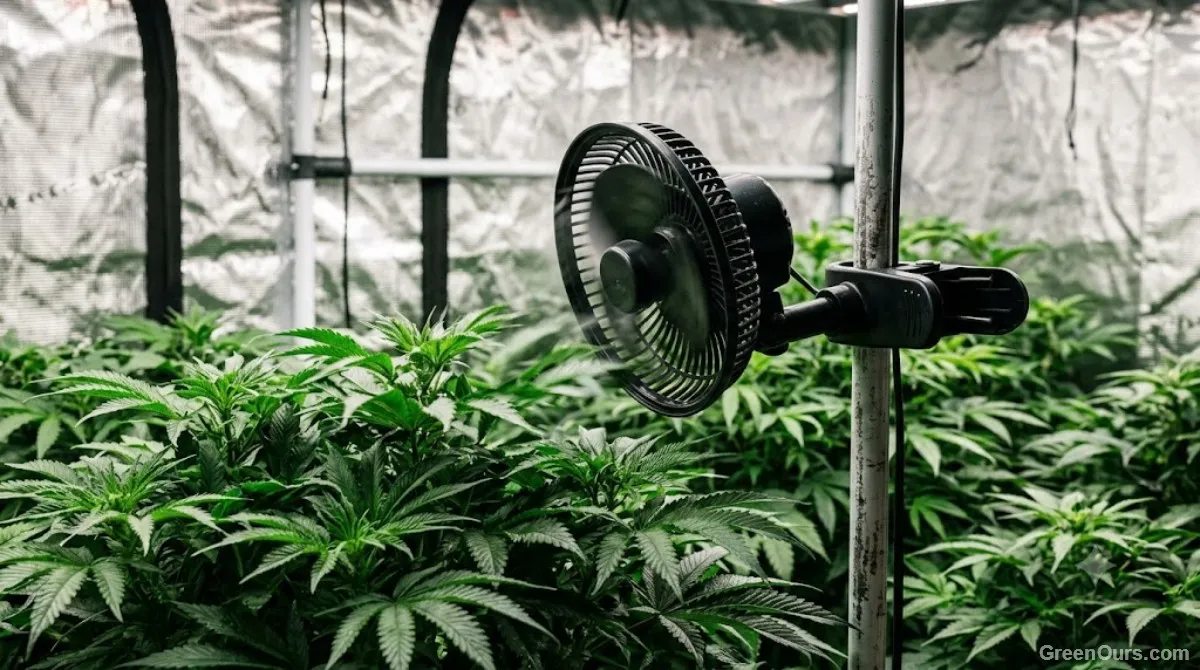
A clip fan mounted at canopy height moves air directly across leaf surfaces. Run it on low-to-medium speed, angled so leaves sway gently rather than flatten. Constant strong wind on young seedlings does more harm than good — aim for barely visible movement, not a windstorm.
Inline Exhaust Fans and Ducting
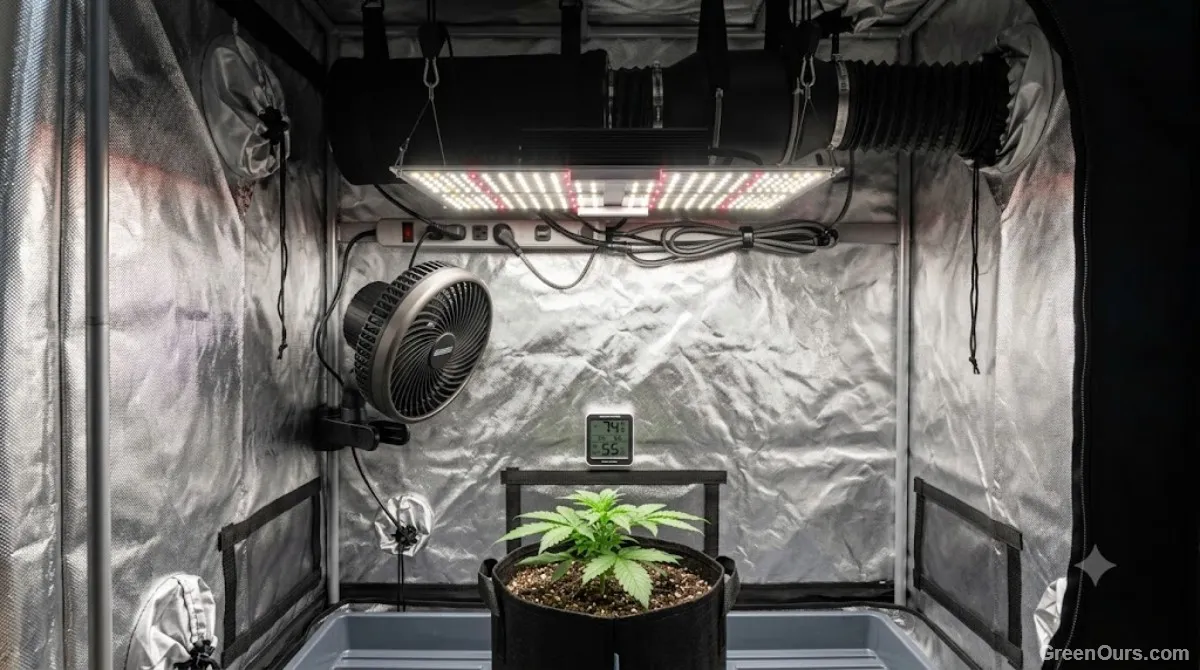
An inline fan paired with carbon filtration and ducting handles the tent's overall exchange: pulling hot, humid air out and pulling fresh air in through passive intake ports. Size the fan to your tent's cubic footage — as a starting point, aim to fully exchange the tent's air volume once every 1 to 3 minutes during the light-on period, adjusting down if you're running heavy odor filtration or up if you're managing high heat from lighting.
To calculate minimum required CFM (cubic feet per minute), multiply tent length by width by height in feet. For instance, a standard 1.2 m x 1.2 m x 2.0 m (4 ft x 4 ft x 6.5 ft) tent totals roughly 104 cubic feet. Accounting for resistance from carbon filters and duct turns, select an inline fan rated for at least 150-200 CFM to maintain negative air pressure reliably.
Ducting installation requires specific attention to routing efficiency. Keep duct runs as short and straight as possible. Every 90-degree turn in flexible aluminum ducting reduces total airflow performance by roughly 20%. Secure all connections tightly using stainless steel hose clamps rather than tape alone to prevent air leaks and maintain negative air pressure inside the tent structure.
Timers: Light and Fan Scheduling
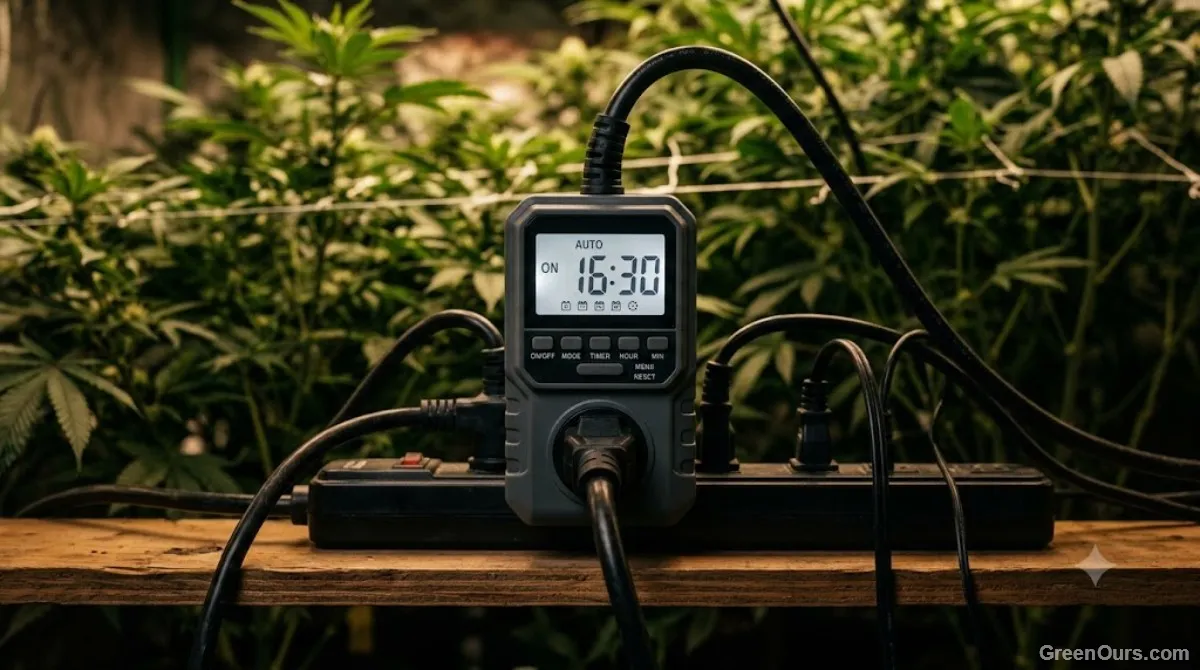
Inconsistent light schedules confuse a plant's internal clock and slow growth. A basic mechanical outlet timer costs under $15 and removes the single biggest source of scheduling error in a home setup: forgetting to flip the light on or off at a consistent time.
Set vegetative lighting to an 18-on/6-off cycle, or 16/8 if you're managing heat buildup. Flowering photoperiod plants typically need a strict 12/12 cycle with zero light leaks during the dark period — even brief interruptions can delay or disrupt flowering. If your setup allows it, put your exhaust fan on the same timer as your light or run it continuously at reduced speed so airflow scales down automatically during lights-off, when heat output drops.
Mechanical timers with grounded 3-prong outlets are preferred over digital units with internal rechargeable batteries. Battery failure in cheap digital units can freeze your light cycle mid-way, causing severe photoperiod disruption without firing an audible error alarm.
Hygrometers and Thermometers: Monitoring Conditions
You cannot manage what you don't measure. A combined hygrometer and thermometer, clipped at canopy height, tells you the two numbers that matter most: temperature and relative humidity at the level where your plants are actually growing — not at the tent's floor or ceiling, where readings skew.
Target ranges shift by growth stage. Seedlings generally do best around 65-75% relative humidity and 21-25°C (70-78°F). Established vegetative plants tolerate a wider range, typically 40-60% humidity and 21-26°C (70-80°F). Flowering-stage plants usually need humidity brought down further, often into the 40-50% range, to reduce mold risk on dense growth. Check your specific plant's requirements, since these ranges vary by species.
Tracking Vapor Pressure Deficit (VPD) through these readings allows precise climate adjustments. VPD measures the difference between pressure exerted by water vapor inside leaf tissue versus surrounding tent air. Maintaining target VPD levels ensures optimal nutrient transpiration through roots without causing stomatal closure or excessive water loss.
Buy a unit with a wired remote sensor if your budget allows it — checking conditions without opening the tent flap prevents the temperature and humidity swings that opening the tent repeatedly causes.
To maintain exact conditions, position sensor probes directly in the central shadow of upper foliage rather than under intense direct light beam radiation. Direct lighting warms physical probe casings artificially, leading to false high temperature readings that do not reflect true ambient tent air temperatures.
Trellis Netting and Support Structures
Once plants reach a certain height, unsupported stems bend under their own weight or under the weight of developing flowers and fruit. Trellis netting, stretched horizontally in one or more layers above the canopy, gives stems something to grow through and lean on without tying off individual branches.
When to Install It
Install netting early — before plants need it, not after they've already started leaning. Retrofitting support onto a plant that's already bent is harder and can snap weak stems in the process. Space the netting grid approximately 15-30 cm (6-12 in.) above your pots during late vegetative growth to guide branch distribution evenly.
As stems push through grid squares, tuck branch tips outward toward perimeter squares rather than allowing central branches to crowd vertically. This technique flattens canopy geometry, ensuring uniform light interception across all leaf surface areas.
Stakes and Ties as an Alternative
For smaller tents or lower plant counts, individual bamboo stakes with soft plant ties can do the same job with less setup time. Choose netting for higher plant density, stakes for a handful of individually managed plants. When using mechanical ties, opt for flexible rubberized wire instead of thin twist-ties to prevent stripping stem bark under heavy growth weight.
Skip These (For Now)
Colored LED spectrum add-ons, CO2 bags without proper sealing to make use of them, decorative reflective wall panels beyond your tent's built-in mylar lining, and app-connected smart plugs that duplicate what a $15 mechanical timer already does — none of these fix a problem most home growers actually have. Buy them later, after a full grow cycle, if you've identified a specific gap they'd solve.
Four categories, four purchases, buy in that order.
Four categories, four purchases, and a clear order of priority. That's the whole list. Everything else can wait until your setup tells you it's needed.