
Why Windows Aren't Enough in Winter
Human eyes are terrible light meters. Our brains automatically adjust for indoor dimness, masking the severe drop in foot-candles that occurs just a few feet away from a glass pane.
When autumn arrives, the angle of the sun shifts, daylight hours shrink, and window glass cuts out vital spectral wavelengths. Plants don't starve slowly; they stall out, dropping lower leaves to conserve energy.
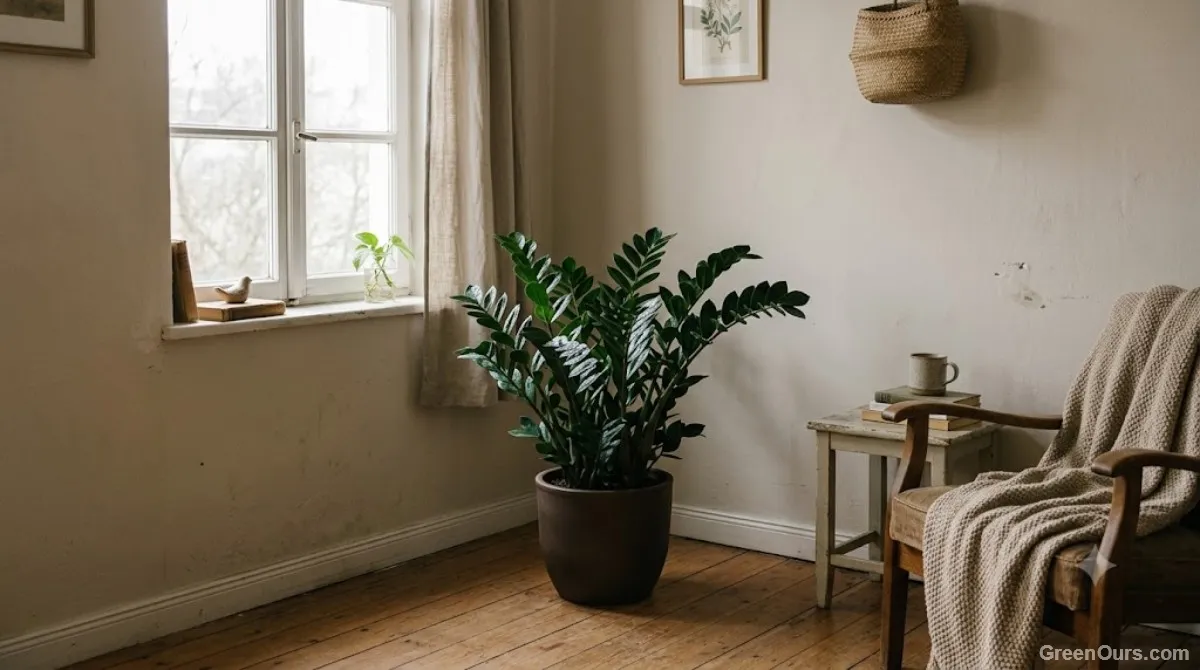
South- and west-facing windows lose the least intensity through fall and winter, but even those windows can drop below 1,000 foot-candles by mid-afternoon in December. North-facing windows commonly sit under 200 foot-candles year-round, a level most flowering houseplants can't use for sustained growth. If you don't know which direction a window faces, check it with a compass app at midday and note whether direct sun ever reaches the glass.
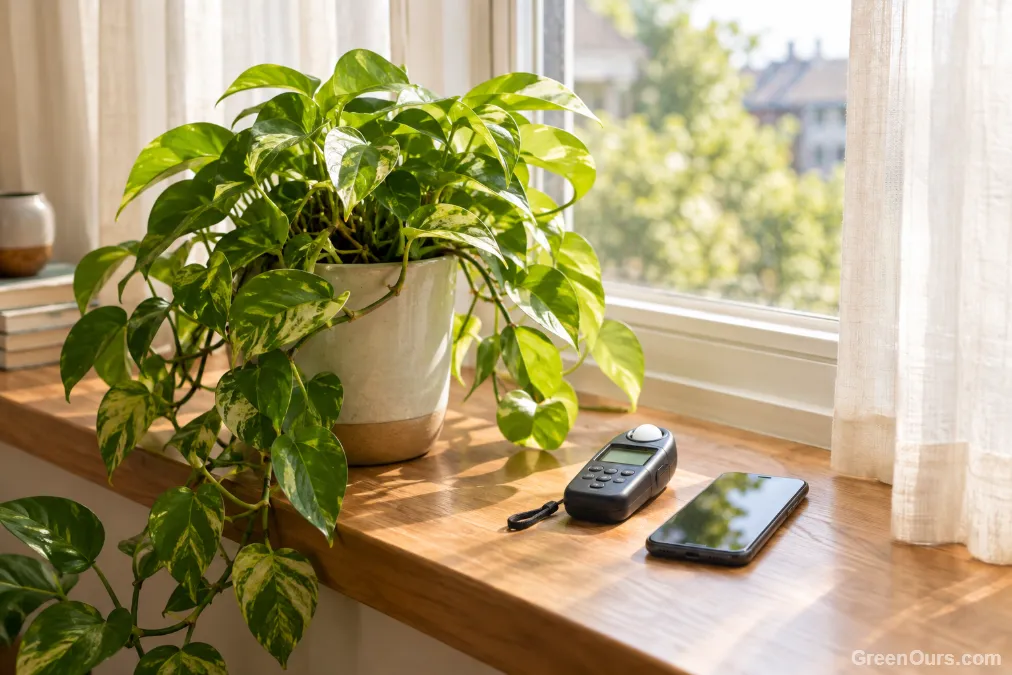
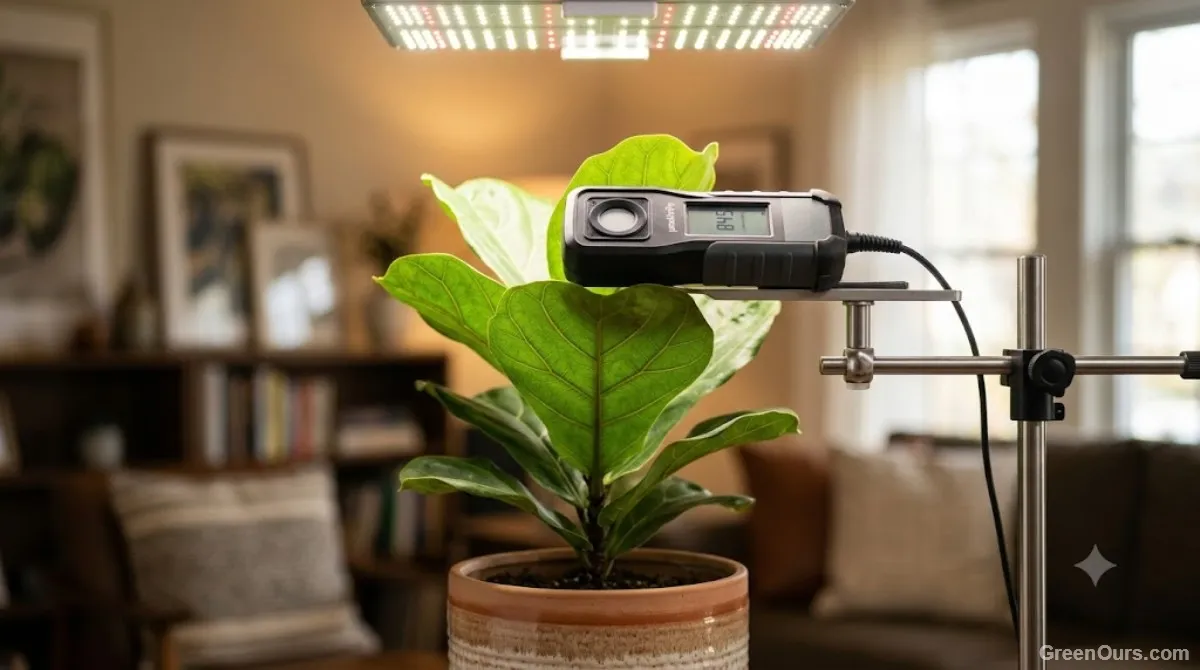
A simple light meter app on your phone won't match a calibrated meter, but it's still more reliable than eyeballing brightness. Take a reading at the exact spot where the plant's canopy sits, not from across the room, and repeat the check in early morning, midday, and late afternoon to see how much the number swings.
The light cliff: Light intensity drops exponentially with distance from a window. Moving a plant just three feet back cuts its available light by up to 75%.
Choosing the Right Light Spectrum and Type
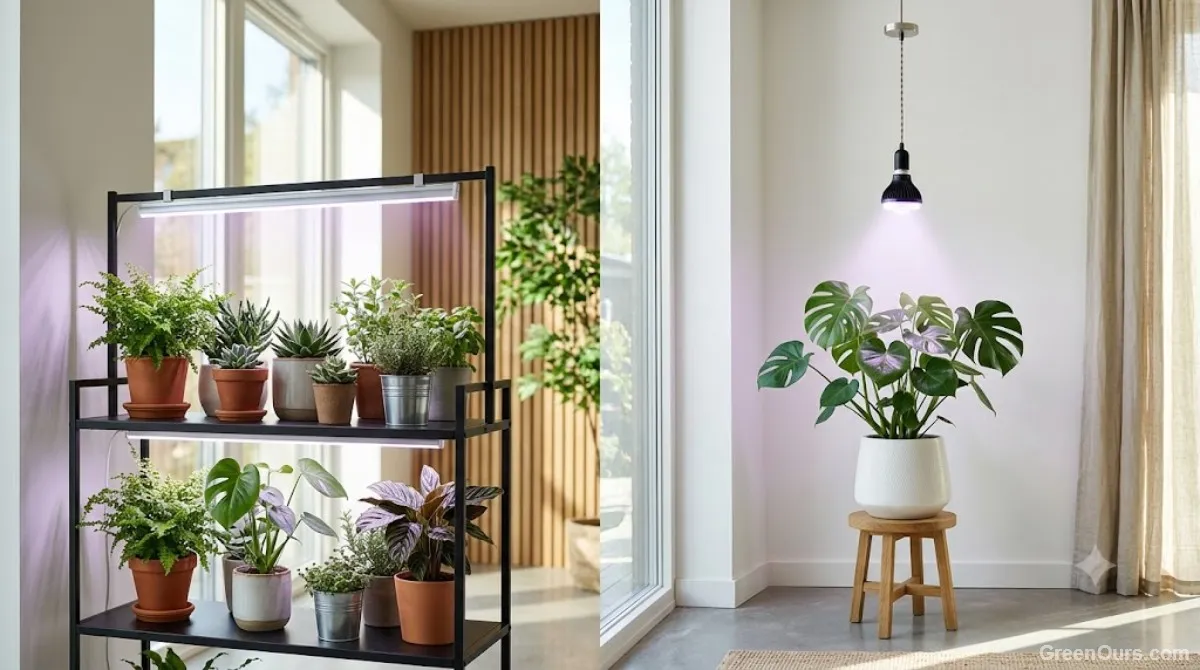
Forget the old purple "blurple" lamps of early indoor horticulture. Modern full-spectrum LED grow lights mimic natural sunlight while focusing energy on the red and blue wavelengths plants use for chlorophyll production.
LED vs. Fluorescent Fixtures
LED panels have largely replaced fluorescent tubes because they run cooler, last longer, and convert electricity directly into usable light rather than ambient heat.
Understanding Kelvin and Lumens
Look for fixtures rated between 5000K and 6500K for leafy green growth (resembling cool daylight) or lower spectrum options if you are encouraging flowering cycles.
Lumens measure how bright a light appears to the human eye, not how much usable energy it delivers to a plant. Two fixtures can carry an identical lumen rating and produce very different growth results, because lumens ignore the red and blue wavelengths chlorophyll actually absorbs. When comparing fixtures, prioritize the PPFD (Photosynthetic Photon Flux Density) rating over lumens whenever the manufacturer publishes one.
Full-spectrum panels replicate daylight and suit a mixed houseplant collection, since foliage, flowering, and propagating plants can all use the same fixture. Targeted red-and-blue panels concentrate energy into the two wavelength bands plants use most efficiently, which can produce faster growth per watt, but the pink-purple cast makes it harder to judge a plant's true leaf color day to day. For a single grow shelf holding assorted houseplants, full-spectrum is the simpler choice.
Dialing In Distance and Duration
Even the most powerful grow light will fail if it sits too far away or stays on for the wrong number of hours. Intensity drops off sharply over distance.
Most foliage houseplants thrive under 10 to 14 hours of daily light exposure. Giving them 24 hours of continuous light disrupts their natural biological clock, preventing the dark-phase cellular repair cycles they require.
Match hours to plant type rather than defaulting to the same schedule for everything. Succulents and cacti that evolved under intense, direct sun generally need at least 12 hours of high-intensity light to maintain compact growth. Low-light tolerant foliage plants, including pothos and ZZ plants, hold up fine on 10 to 12 hours. Seedlings and cuttings benefit from the long end of the range, up to 16 hours, while they're building root mass before they can be hardened off under natural light.
Common Setup Mistakes to Avoid
Setting up a grow light feels straightforward, but small configuration errors often stall results:
- Ignoring heat output: Even LEDs emit localized heat close to the diodes. Keep lights a safe 12 to 18 inches away from tender tropical foliage to avoid leaf scorch.
- Relying on desk lamps: Standard household LED bulbs lack the necessary PAR (Photosynthetically Active Radiation) output to drive real growth unless fitted with specialized horticultural diodes.
- Forgetting timers: Consistency dictates success. Plug your fixture into a basic mechanical or digital timer to maintain a reliable photoperiod every single day.
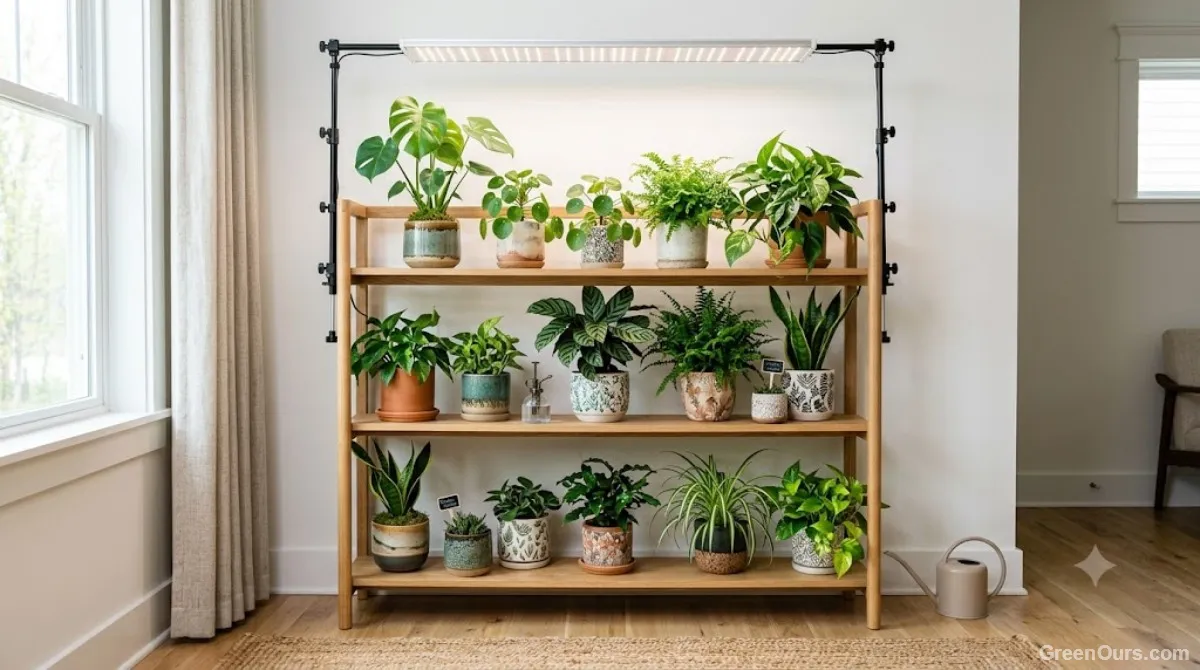
- Skipping reflective surfaces: Light that misses the canopy and hits a dark wall or floor is wasted. Line grow shelves with white poster board or reflective mylar to redirect stray light back onto the leaves.
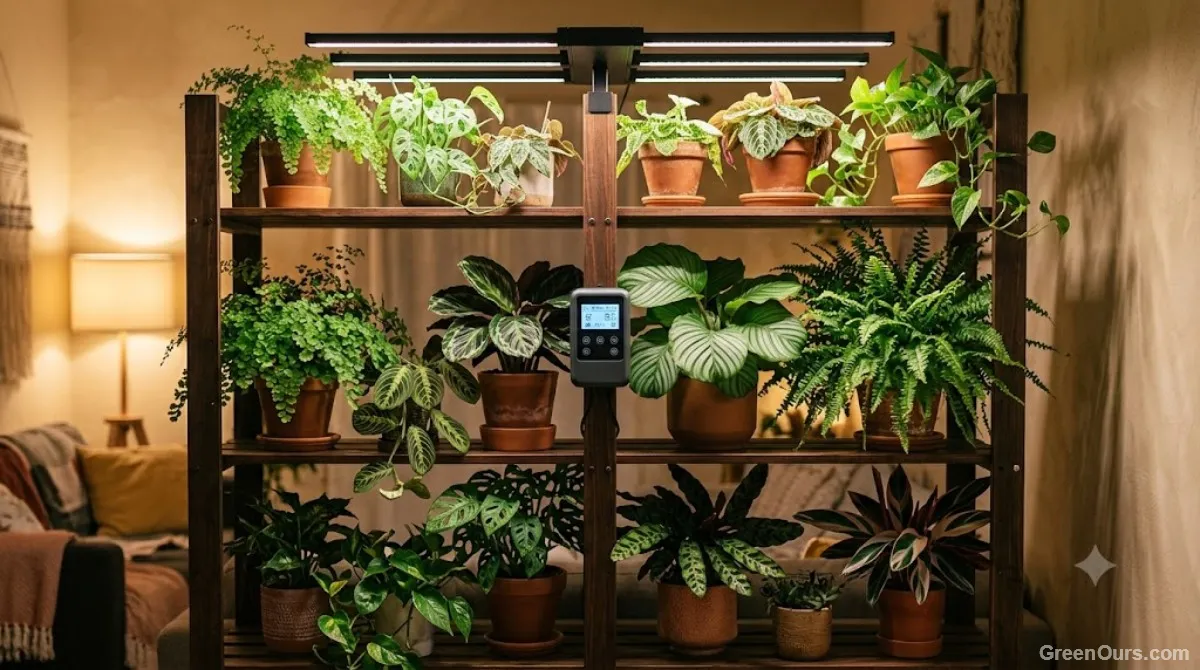
- Placing every plant at the same height: A single fixture rarely delivers even intensity edge to edge. Move light-hungry plants toward the center of the coverage area and shade-tolerant plants toward the outer edges instead of assuming uniform output.
- Ignoring seasonal adjustment: A schedule set in October often needs a one- to two-hour extension by January as natural daylight keeps shrinking. Revisit timer settings each month rather than setting them once and forgetting them.
What to Do Next
Assess your dimmest collection corner today and measure the distance from your proposed fixture mount to the top canopy of your struggling plants. Start with a 12-hour timer schedule, monitor how the foliage reacts over the next two weeks, and make micro-adjustments to height rather than changing everything at once.
Track leaf color and node spacing weekly for the first month — new growth that's noticeably darker and more compact than what came before confirms the setup is working.
Equip your indoor space with the right tools to keep your collection thriving through every season.