
What an Infrared Thermometer Actually Measures
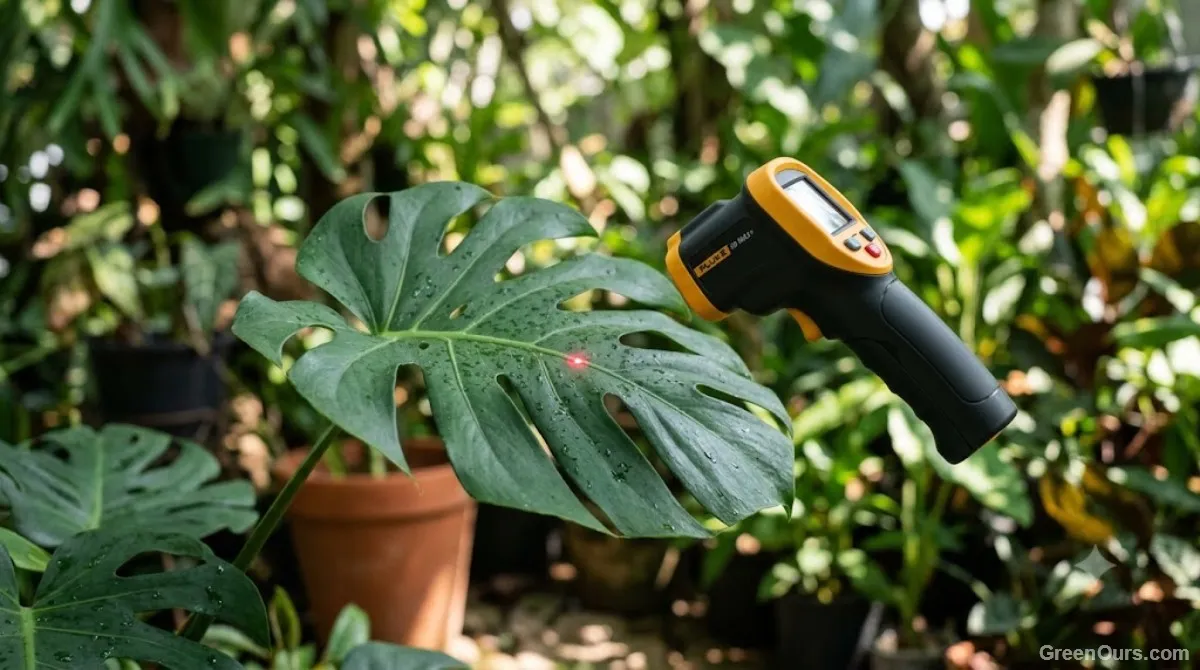
An infrared thermometer for plants reads radiant heat coming off a surface, not the air temperature around it. Point it at a leaf and it reports that leaf's surface temperature, converted from the infrared energy the tissue is emitting. Consumer units aimed at cooking or HVAC work fine on plants because most foliage has an emissivity value between 0.95 and 0.98 — close enough to the factory-set default on nearly every basic model that no adjustment is needed.
Accuracy on a $20 to $40 handheld unit typically runs within ±3.6°F (±2°C). That's tight enough to catch a meaningful stress signal, which is usually a swing of 4°F or more from baseline. Distance matters: most units have a distance-to-spot ratio around 10:1, meaning a reading taken from 10 inches away averages temperature across roughly a 1-inch circle. Get too far back and you're averaging leaf and background air, which blurs the number you actually want.
Leaf Temperature vs. Soil Temperature: Why the Gap Matters
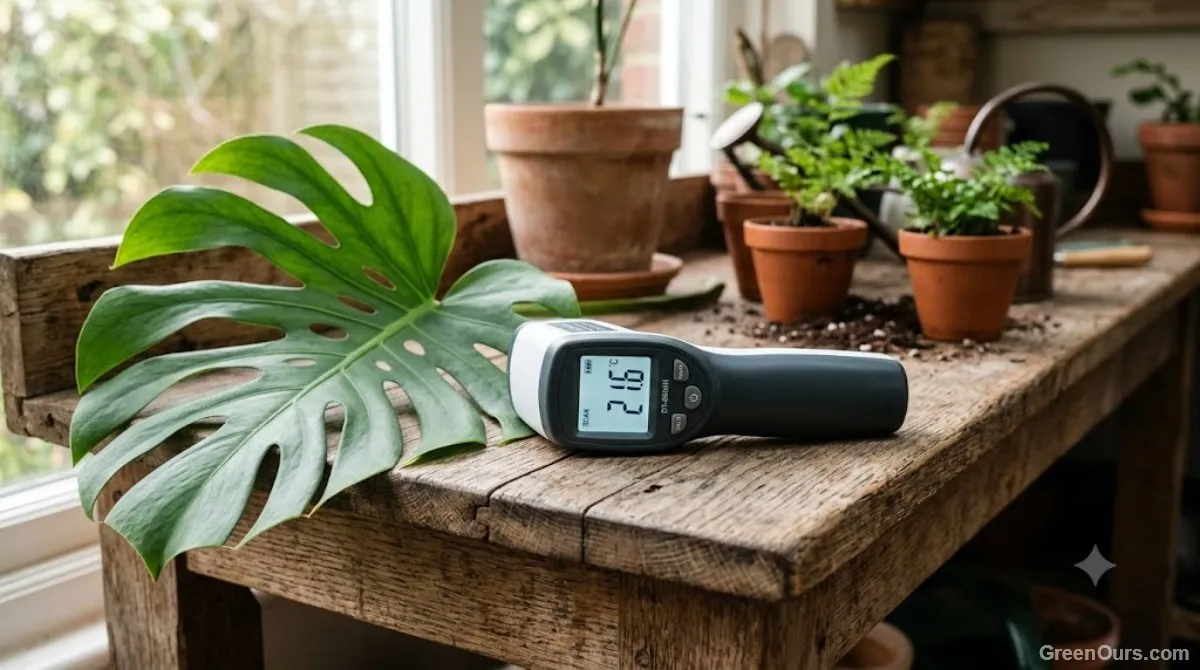
A healthy, well-watered leaf usually sits 2°F to 10°F below air temperature. That gap exists because transpiration — water moving out through open stomata — cools the leaf the same way sweat cools skin. When a plant is under stress, the stomata close to conserve water, the cooling effect stops, and leaf temperature climbs toward or past air temperature. Soil moisture readings don't capture any of this. A pot can test wet at the probe while the leaf tissue is already signaling that water isn't moving through the plant.
Before diagnosing anything, build a baseline. Measure the air temperature in shade near the plant, then measure a known-healthy leaf on the same species. That gap — not the raw number — is what you compare against when checking a plant you're worried about.
Three Situations Where Leaf Temperature Catches Problems Early
These three scenarios cover most of what a home or small-scale grower actually needs an infrared thermometer for. Each one hinges on the same principle: a stressed leaf's temperature shifts before wilting, yellowing, or drooping show up to the eye.
Heat Stress Before Wilting Starts
Once a leaf's temperature meets or exceeds air temperature, stomatal closure has already begun. On tomatoes and peppers, an air reading of 95°F paired with a leaf reading of 97°F or higher is a clear signal to provide shade cloth or deep water within the hour — not tomorrow. Catching this before visible wilting means the plant loses less flowering and fruit set during the recovery window.
Transplant Shock in the First 48 Hours
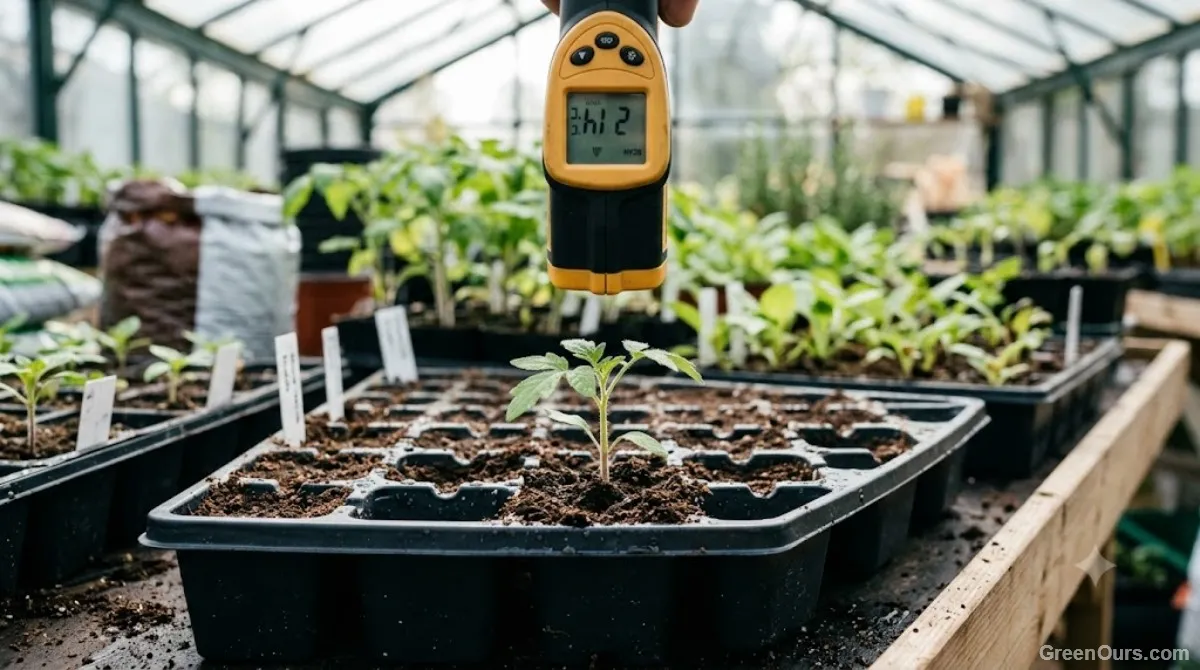
New transplants have root systems that haven't re-established contact with surrounding soil, so water uptake lags behind the demands of the leaves. Checking a transplant's temperature at morning and again at midday on day one and two is useful: a swing of more than 5°F between those readings, especially compared to an established plant of the same species nearby, points to a root system still catching up. This is normal for a day or two — it's a problem if the gap persists past 72 hours.
Irrigation Timing Beyond the Moisture Meter
A soil moisture meter tells you what's in the pot. It doesn't tell you what's reaching the leaves. Salt buildup, compacted roots, or localized dry pockets can leave soil reading moist while the plant is still functionally dehydrated — the leaf temperature reading catches that mismatch because it reflects whether water is actually moving through the plant, not just sitting in the container.
When an Infrared Thermometer Adds Little Value
Thick-leaved and waxy-leaved houseplants, along with succulents that run CAM photosynthesis, keep their stomata closed for much of the day as a normal part of their biology. A leaf temperature reading on these plants doesn't carry the same diagnostic weight, because a warm reading can simply be normal behavior rather than a stress signal. The tool is also useless as a single, isolated data point — without a baseline comparison, one reading tells you almost nothing. For routine watering decisions on a windowsill collection of pothos and philodendrons, a soil moisture meter remains the faster, more direct tool. The same caution applies in reverse during cold snaps — a leaf reading below air temperature on a cold, clear night is often just radiative cooling, not a stress signal, so don't over-read a single low number either.
How to Get an Accurate Field Reading
- Measure ambient air temperature first, in shade, near the plant you're checking.
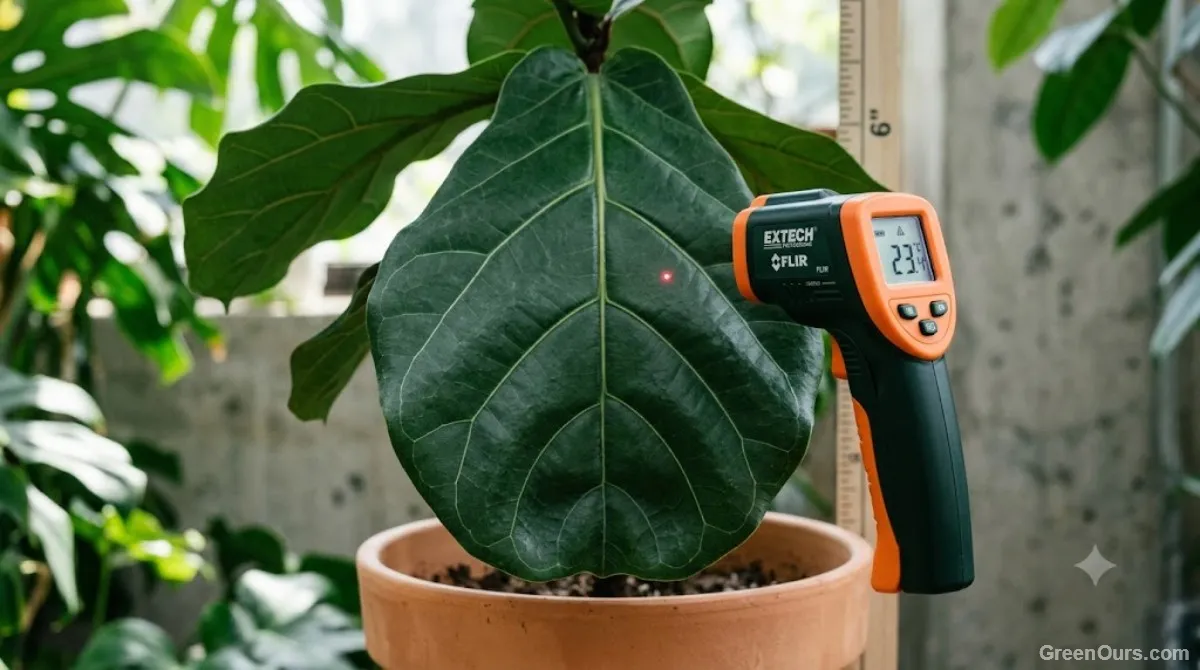
- Hold the thermometer six to ten inches from the leaf, aimed perpendicular to the surface to avoid glare skewing the reading.
- Target the largest fully expanded leaf on the plant — avoid thin leaf edges, which read inconsistently.
- Take three readings across different parts of the canopy and average them.
- Log the result and compare it to the same plant, same time of day, on subsequent days rather than judging a single reading in isolation.
What to Look for When Buying One
Skip units under $10 — their accuracy tolerance often runs ±5°F or wider, which is too loose to catch an early stress signal reliably. A $25 to $40 handheld model with ±3.6°F accuracy and a laser sight for aim is enough for hobbyist and small-greenhouse use. Adjustable emissivity is a nice-to-have rather than a requirement for most foliage, since the factory default already sits close to typical leaf values; it becomes more useful if you're regularly checking waxy-leaved plants with lower emissivity, where the default setting reads less accurately.
Battery life matters more than most buyers expect. A unit that eats coin-cell batteries every few weeks becomes a unit that sits in a drawer. Check the listed battery type and look for user reviews mentioning long stretches between changes, and confirm the laser sight is a genuine aiming aid — Class II or lower — rather than a bright, unregulated diode that's uncomfortable to use outdoors in full sun. One handheld model that consistently meets these specs, and is worth naming directly rather than describing in the abstract, is the Etekcity Lasergrip 774.
Measure the gap, not just the number.
This isn't a tool every windowsill needs. But for anyone running seed trays through a heat wave, moving transplants into ground beds, or managing more than a handful of containers where visual checks aren't fast enough, it closes a real gap between what the soil says and what the plant is actually doing.