
How a Moisture Meter Actually Works
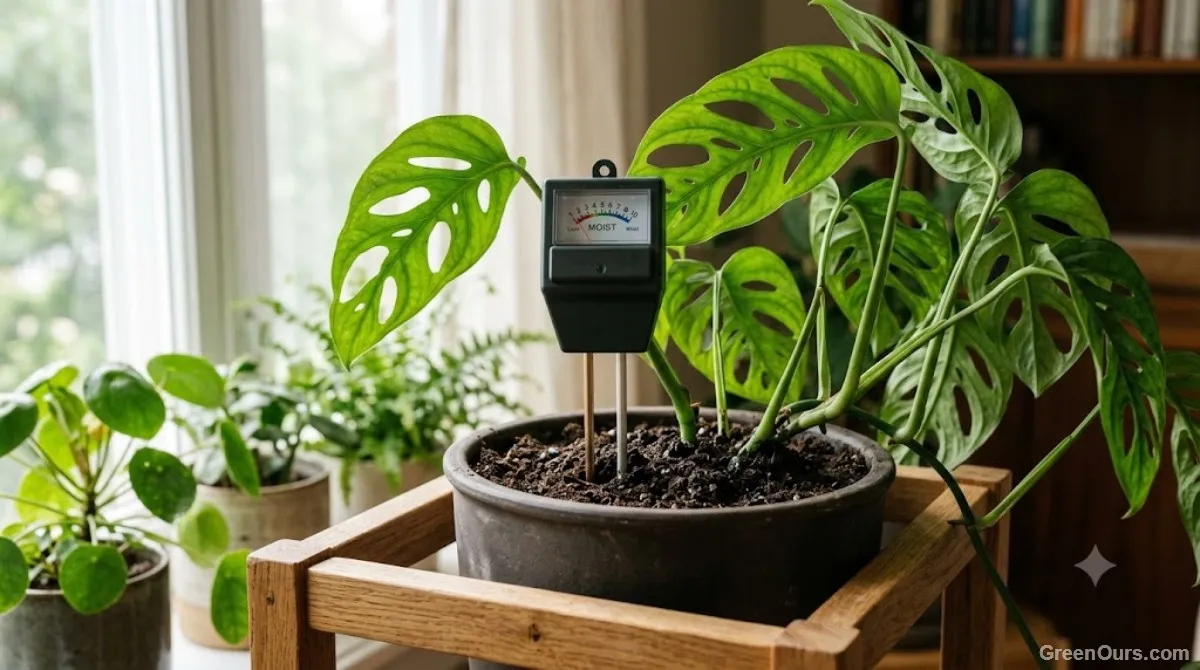
Most consumer meters fall into one of two categories: resistance-based and capacitance-based. Resistance meters use two metal prongs. Water conducts electricity; dry soil resists it. The meter runs a small current between the prongs and converts the resistance into a number on the dial. It's cheap technology, and it's the type sold in most garden centers for under ten dollars.
Capacitance meters work differently. Instead of running current directly through the soil, they measure changes in a low-level electrical field around the probe tip. This means the metal doesn't need direct, uncorroded contact with wet soil to register a change, which is the main weakness of resistance models over time.
Both types translate an electrical signal into an estimate, not a direct water measurement. That's an important distinction, because anything else in the soil that conducts electricity can throw the number off.
Reading the Dial Without Overreacting to It
Most meters use a 1–10 scale, loosely grouped into dry, moist, and wet bands. A reading of 1–3 usually signals dry soil. 4–7 sits in the moist range most houseplants prefer. 8–10 indicates saturated, often waterlogged, soil.
Treat those bands as starting points, not universal rules. A succulent that thrives at a 2 would sulk if you kept it at a 5. A fern that wilts below a 6 has different needs entirely. The number only becomes useful once you know where your specific plant sits comfortably within it.
A single reading tells you almost nothing. Track the number over several days and watch the trend — a slow drop from 7 to 3 tells you far more about your pot's drainage than any one snapshot does.
Where Accuracy Breaks Down
Soil Composition and Compaction
Chunky aroid mixes, heavy perlite blends, and anything with large air pockets create inconsistent contact between the probe and the surrounding medium. Insert the same meter twice, half an inch apart, and you can get two different readings in the same pot. This isn't a faulty meter — it's a probe reading whatever happens to be touching it at that exact point.
Fertilizer Salts and Mineral Buildup
Dissolved fertilizer salts increase the soil's electrical conductivity independent of actual water content. A pot that's genuinely dry but carrying salt buildup near the surface can register as moist, which is one of the most common ways these devices produce a false sense of security. Corrosion on the prongs of an older resistance meter has the opposite effect, gradually dragging every reading lower over months of use even when nothing about the soil has changed.
Calibrating a New Meter Before You Trust It
Run two quick checks before relying on any meter for real decisions. Submerge the probe in a glass of distilled water — it should read near the top of the scale within a few seconds. Then dry the probe completely and press it into a bone-dry paper towel; it should drop close to zero. If either result is far off, the unit is unreliable and no amount of careful technique will fix that.
Once it passes both checks, test it against a plant whose watering status you already know with certainty — one you watered thoroughly yesterday, for instance. If the reading doesn't roughly match what you'd expect, recalibrate your expectations of the device rather than the plant.
Probe Placement Changes the Number
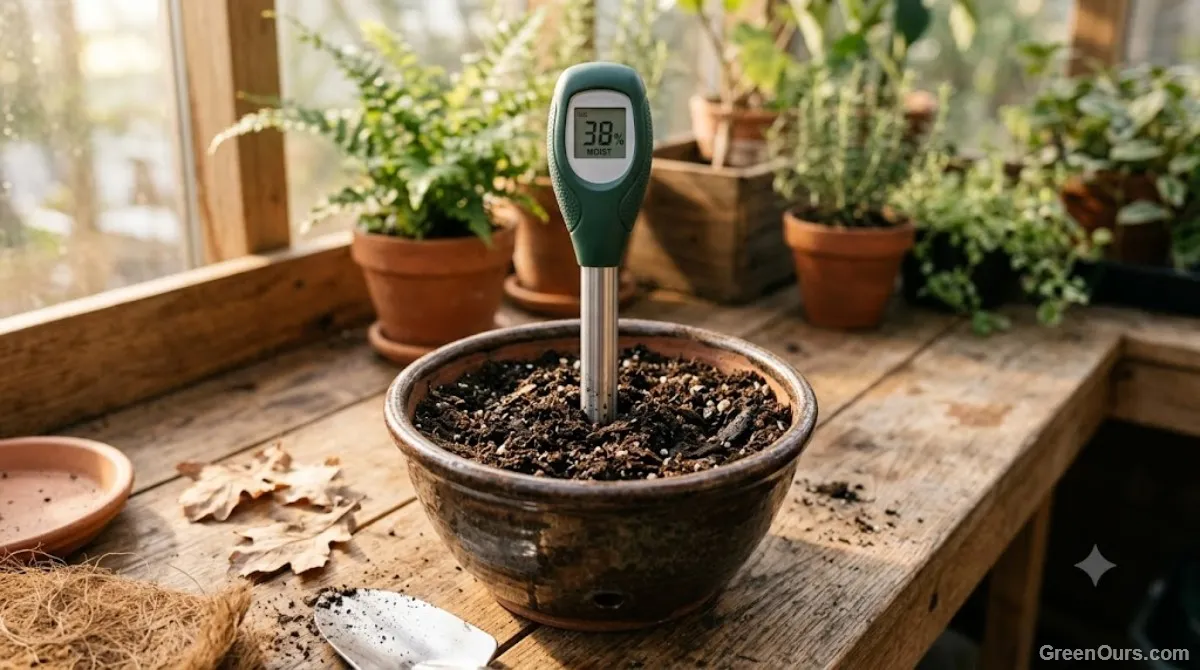
Depth matters more than most people assume. A probe pushed only an inch into the surface will often read dry while the root zone several inches down is still fully saturated, especially in taller containers. Insert the probe to roughly two-thirds of the pot's depth, avoiding the drainage holes at the very bottom, and take two readings on opposite sides of the pot rather than trusting a single insertion point.
When Your Finger Is Still the Better Tool
A finger test picks up on things a single numeric reading can't: soil texture, whether the mix has pulled away from the pot's edge and created a channel for water to bypass the roots entirely, and the subtle difference between damp-and-airy versus damp-and-compacted. Meters also struggle in small containers — a probe built for a six-inch pot will bottom out or barely register anything meaningful in anything smaller.
The most reliable approach uses both. Reach for the meter on large pots, deep containers, and outdoor beds where your finger can't reach the root zone. Reach for your finger on small pots, new plants you're still learning, and any time the meter's reading doesn't match what the plant is actually telling you through its leaves.
Is a Moisture Meter Worth Buying?
For anyone managing more than a handful of pots, or with a documented history of overwatering, a capacitance meter earns its cost. It removes guesswork on the plants most prone to root rot and holds up better over years of use than resistance models, which corrode and drift.
For a windowsill with three or four plants you already check daily, the cost isn't justified. A finger test costs nothing, works instantly, and tells you everything a cheap meter would tell you anyway.
Buy a capacitance meter if you're going to rely on the number it gives you. Calibrate it once against water and a dry towel. Then let your finger settle any disagreement it has with the dial — the two together will catch more problems than either one working alone.
Want the fundamentals behind the number on the dial? Read our full guide to watering indoor plants correctly.