
Why One Weekly Pass Beats a Daily To-Do List
Daily eco-habits sound great until you're the one adding "check the compost" to a to-do list that already has forty things on it. Most of those habits quietly disappear within a couple of weeks — not because you're lazy, but because daily anything requires daily willpower, and willpower runs out.
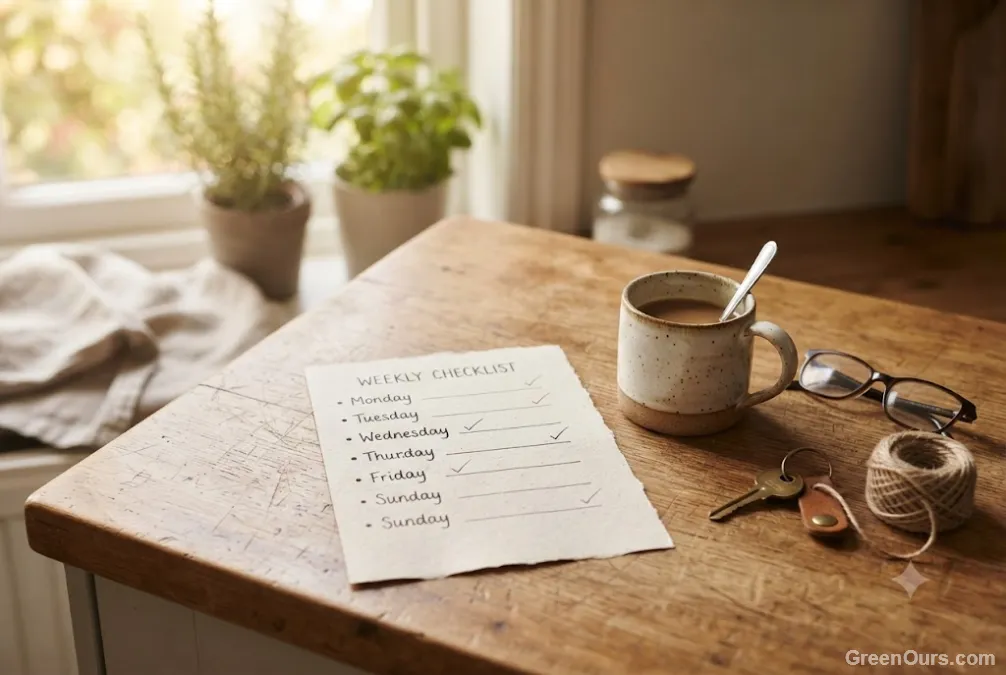
A weekly reset works differently. It's one appointment with yourself, not seven. You're not trying to remember to do it every day — you're trying to remember it once, ideally tied to something that already happens, like Sunday coffee or the night before trash pickup. That single anchor point is what makes it stick past the first month.
Pick your anchor day by working backward from something that already has weight in your week — trash night, grocery day, whatever you're least likely to skip. Tying the routine to an existing habit removes the one variable that usually kills new habits: remembering to start.
I learned this the hard way with a composting habit I tried to run daily. It lasted exactly nine days before the counter bin turned into a science experiment I was too embarrassed to deal with. Swapping it for a once-a-week check-in didn't make me more virtuous — it just matched the effort to how much attention I actually had to give it.
Walk the House in Four Stops, Timer Running
Set a timer for fifteen minutes and move through the house in a fixed loop. The order matters less than the consistency — pick one and repeat it every week so you stop having to think about where to start.
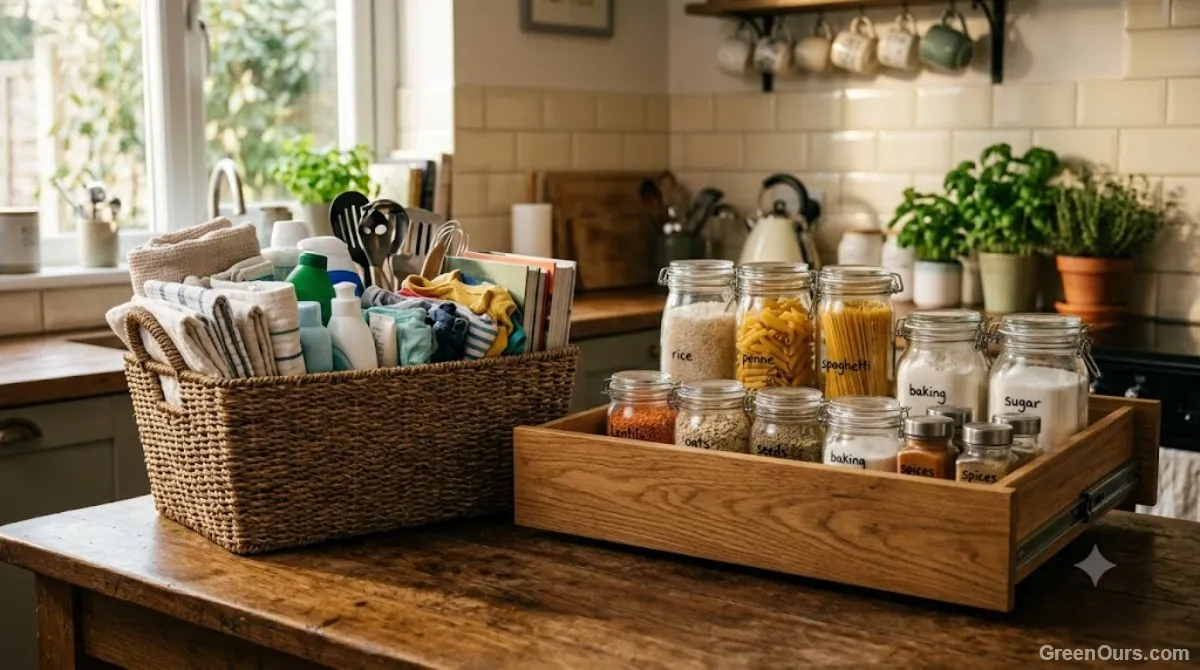
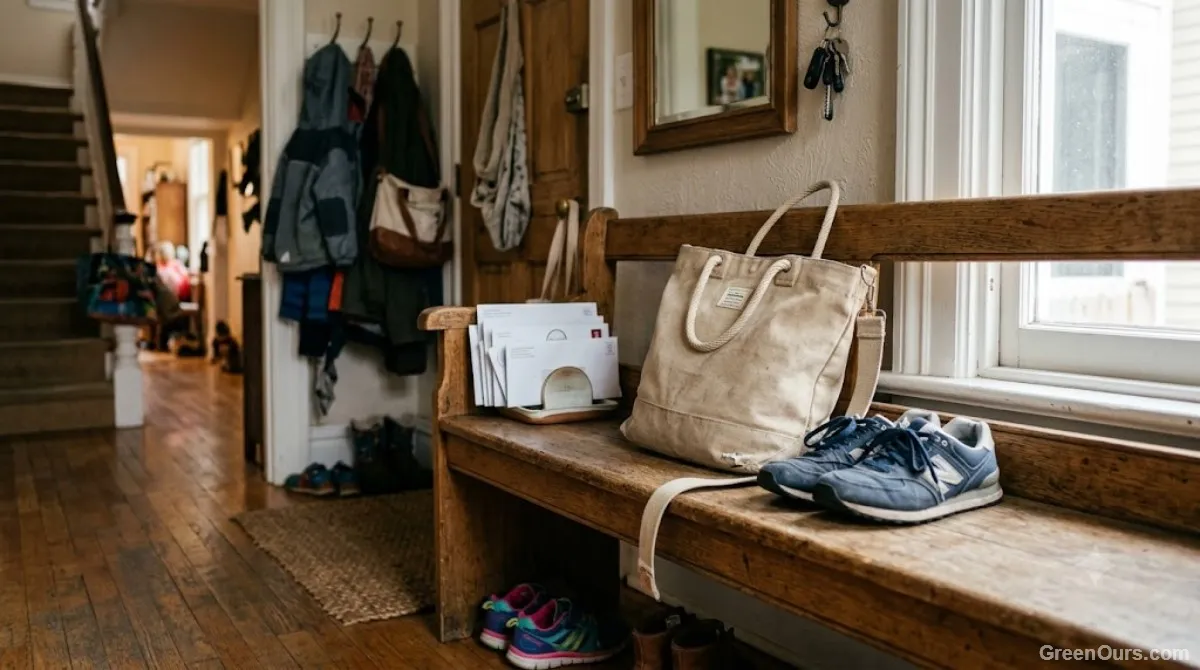
A workable loop looks like this: kitchen counters and fridge, the mail and paper pile wherever it lands, the recycling and trash bins, and one "catch-all" zone — the entryway bench, the junk drawer, whatever spot in your house collects things that don't have a home yet.
This is really the backbone of a weekly sustainable home routine — not a rigid system, but a loop simple enough that you could describe it to someone else in one sentence. If you can't remember your own routine, it's too complicated, and you'll quietly stop doing it the first busy week that comes along.

The goal of each stop isn't to deep-clean it. It's to ask one question: does anything here need to leave the house, get recycled, or get put away? That's it.
What This Looks Like When Your Household Is a Mess Most Days
If you live with kids, roommates, or anyone who treats the kitchen table as a landing pad for everything, a spotless weekly reset isn't realistic, and it doesn't need to be. The routine still works — it just moves faster because you're triaging, not organizing.
In a busier home, the entryway stop might just mean sorting shoes into a bin and pulling anything expired out of the coat pockets. The mail stop might mean recycling the junk without opening it and putting bills in one spot, full stop. You're not aiming for a magazine photo. You're aiming for "better than it was fifteen minutes ago," every single week.
I've run this same loop in a house with two kids, a dog who treats the doormat as a chew toy, and a partner who "organizes" by moving piles from one flat surface to another. Some weeks the entryway stop is genuinely just corralling shoes into a bin and fishing a granola bar wrapper out of a backpack pocket. It still counts. The point was never a perfect house — it was a house that doesn't quietly get worse while nobody's looking.
The Checklist That Actually Fits in 15 Minutes
Kitchen (roughly 4 minutes)
Clear the counter of anything that's not food-related. Check the fridge for one item that's about to turn — use it, freeze it, or compost it before it becomes trash by default.
Paper and mail (roughly 3 minutes)
Recycle anything unopened that doesn't need action. File the rest into one folder or basket instead of letting it spread across three surfaces.
Bins and containers (roughly 3 minutes)
Take stock of what's overflowing versus what's barely used. If the recycling is always full by Wednesday, that's useful information — it might mean adjusting what you're buying, not just taking it out more often.
The catch-all zone (roughly 5 minutes)
Pull three things that don't belong there and either put them away, donate them, or toss them. Three is a deliberately small number — it keeps this stop from turning into an hour-long excavation.
None of these four stops are meant to be exhaustive — that's on purpose. The second you turn one of them into a project, you've broken the fifteen-minute promise that makes the whole routine sustainable in the first place.
If you live in a smaller space, the four stops can collapse into two — the kitchen and one catch-all zone tend to absorb everything else. In a larger house, you might add a fifth stop for a bathroom counter or hallway closet. The number of stops matters less than keeping each one under five minutes.
When You Skip a Week, and Why That's Not a Failure
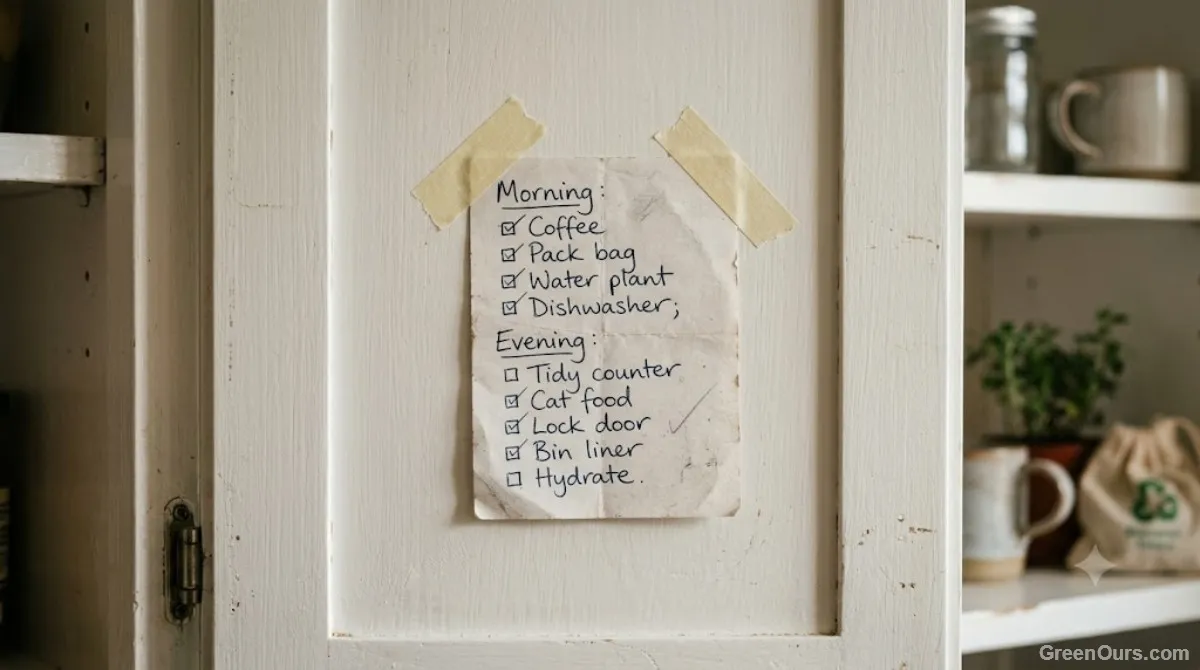
You will skip a week. Maybe more than one. The routine isn't broken because of that — it's just waiting for you to pick it back up, and picking it back up is the entire point. A missed week doesn't erase the ones before it.
What tends to derail people is treating one skipped reset as proof the system doesn't work, then abandoning it altogether. Give yourself permission to do a shorter version — even five minutes on the kitchen counter — rather than none at all. Consistency, not intensity, is what makes this last.
I've had entire months where the timer never got set — a move, a stomach bug that took out the whole house, a stretch where just getting dinner on the table felt like an accomplishment. The house got messier during those stretches, and that's fine. What mattered was that restarting didn't require relearning anything. The loop was still there, waiting, exactly where I'd left it.
You'll know the routine's working when the big seasonal cleanout starts feeling optional instead of overdue. That's really the marker — not a spotless house, but one that never quite gets bad enough to dread walking into.
Ready to try it? Pick your loop, set a fifteen-minute timer, and see how your Sunday feels afterward.