
What Reusable Paper Towels Actually Are
Before we get into whether they're worth it, it helps to know what you're actually buying, because "reusable paper towels" covers a surprisingly wide range of products. Some are just flannel or cotton squares cut to paper-towel size. Others are terry cloth, which grabs grease better. A few brands sell bamboo or hemp blends that dry faster and resist odor longer, though they usually cost more upfront.
What they all have in common is simple: instead of tearing off a sheet and tossing it, you wipe, rinse or toss it in a bin, and wash it with your regular laundry. That's the whole mechanism. There's no special equipment, no learning curve beyond remembering where you put the bin.
The Roll-Style Versions
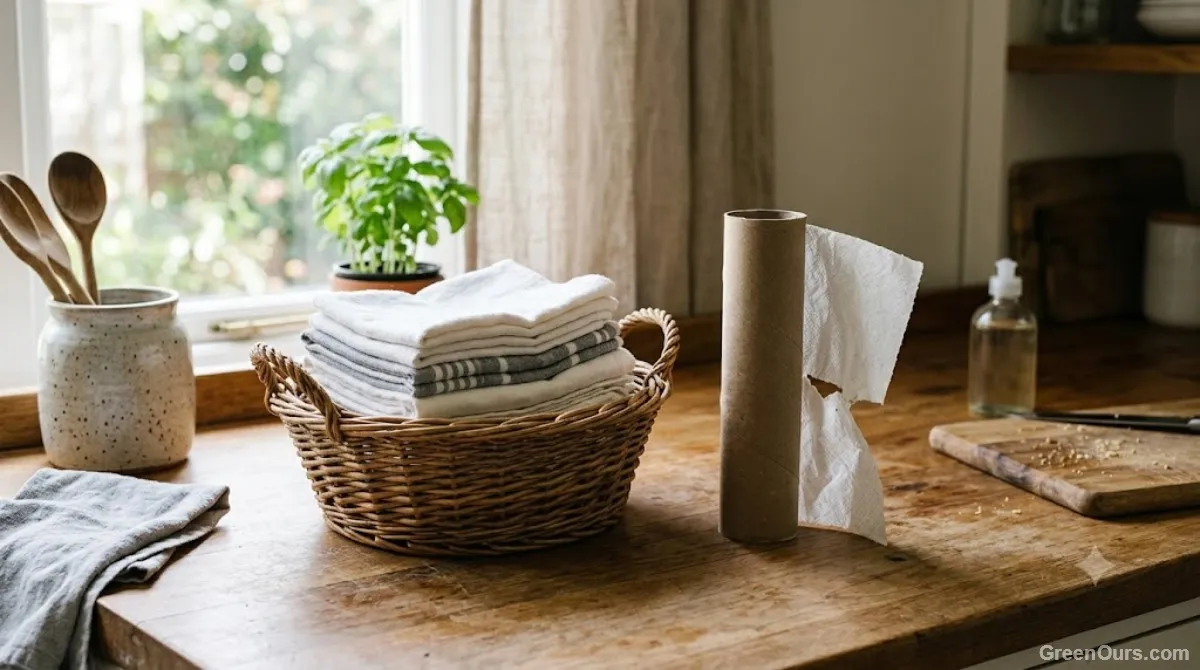
Some brands sell them on an actual cardboard roll, snapped together with buttons so they look and dispense like a normal paper towel roll. I'll be honest — I found this more gimmick than benefit. Unsnapping a towel to wash it and resnapping it after is an extra step I didn't need. A simple folded stack in a basket did the same job with less fuss.
If you're testing the waters, skip the roll-style sets. A basket of 10–12 flat squares does everything the fancier version does, minus the snaps you'll eventually stop bothering with.
The Real Math: Do They Actually Save Money?
I tracked this for four months because I didn't trust the marketing claims, and I didn't fully trust my own optimism either. Before switching, my household went through roughly two rolls of paper towels a week — call it 8 rolls a month. After switching to a 12-pack of reusable towels, I still buy paper towels, just far fewer: about one roll every six to eight weeks, for the genuinely gross jobs I don't want touching cloth.
The upfront cost of a decent 12-pack ran close to what I used to spend on paper towels in three or four weeks. After that, the ongoing cost is basically the extra water and detergent from washing them, which is small enough that I couldn't isolate it on my utility bill. By month three, the math had clearly tipped in favor of the reusable set, and it kept tipping further every month after.
That said, the savings aren't dramatic if you were already a light paper towel user. If your household goes through less than a roll a week, the break-even point stretches out much further, and the convenience factor matters more than the money.
The Cleaning Routine Nobody Fully Explains
This is where most reviews get vague, so let me be specific. I keep a small lidded bin under the sink for used towels. Anything that touched raw meat or something seriously questionable goes straight into a hot wash, not the bin — that's a hard rule in my house. Everything else sits in the bin until laundry day, usually with a load of kitchen linens and dish towels.
Washing and Drying
Hot water, regular detergent, no fabric softener — softener coats the fibers and makes them less absorbent over time, which took me an embarrassingly long time to figure out. They dry fine on a normal cycle, though air-drying extends their life if you have the patience for it, which most days I don't.
Where They Genuinely Fall Short
I won't pretend this is frictionless. There are jobs I still reach for actual paper towels: draining bacon, wiping up something a pet left behind, or cleaning anything I don't want anywhere near my washing machine. Pretending reusable towels replace disposables entirely isn't honest, and articles that claim otherwise are setting people up to feel like they failed at something that was never fully achievable.
Who Actually Benefits From Making the Switch
Households that go through paper towels fast — multiple kids, pets, a lot of home cooking — see the biggest payoff, both in savings and in how quickly the reduced grocery-store trips add up. If you're already someone who does laundry every few days regardless, adding a handful of towels to the load costs you almost nothing extra in time or effort.
If you live alone, travel a lot, or genuinely use less than a roll a month, I'd say hold off. The savings are marginal, and the extra bin, extra laundry step, and extra thing to remember might not be worth it for the waste you'd actually be cutting.
If You Only Do One Thing
Don't throw out your paper towel roll and go all in on day one. Buy a small set — six or eight squares — and use them alongside what you already have for a couple of weeks. See where they fit into your actual routine before committing to a full switch. That's the version of this swap that actually sticks, instead of the all-or-nothing approach that usually ends with a basket of cloth squares gathering dust in a drawer.
Test it small before you commit — that's the version that actually sticks.
I still keep a roll of paper towels in the house, and I've stopped feeling weird about that. The point was never to eliminate them completely — it was to stop throwing money and waste at a habit I could easily cut down. Four months in, that's exactly what happened, one folded square at a time.