
Quick Takeaways
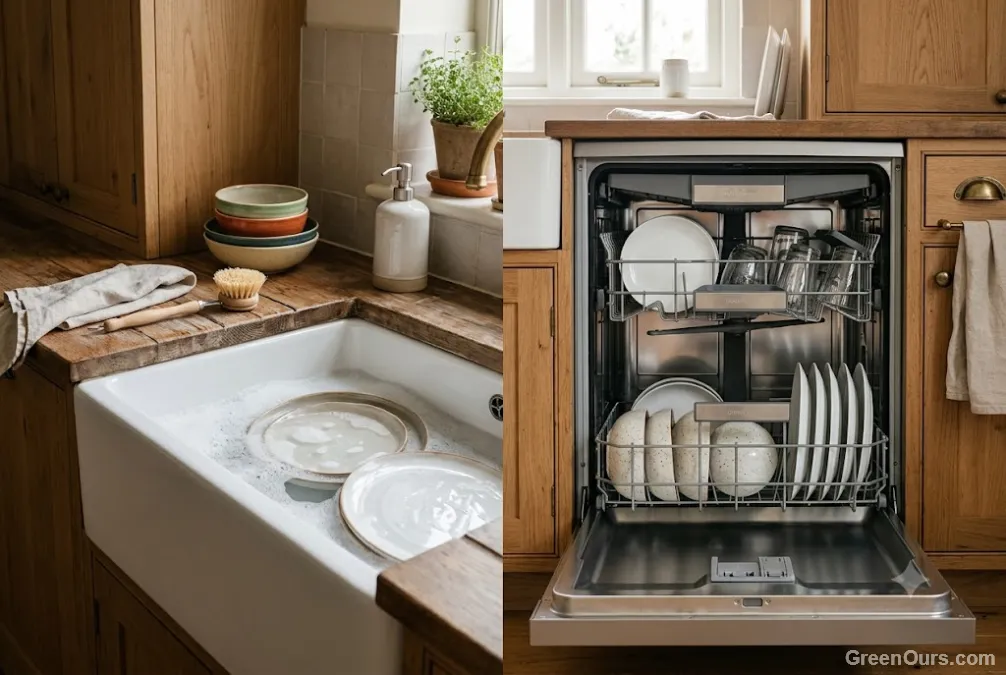
- A certified dishwasher, run reasonably full, usually beats the open tap on water use.
- Scrape plates, skip pre-rinsing and use no-heat drying when practical.
- For a few dishes or delicate items, a two-basin wash can make more sense.
Dishwasher vs. Handwashing: Quick Comparison
There is no single water or energy figure that applies to every dishwasher and handwashing routine. Results depend on the appliance, faucet flow, washing time, water temperature and number of dishes. These examples use a dishwasher-sized batch rather than comparing a full machine with just a couple of mugs.
| Method | Illustrative water use and key factors |
|---|---|
| ENERGY STAR certified standard-size dishwasher | Up to 3.2 gallons per cycle under the certification criteria. Actual use depends on the model and cycle. |
| Handwashing under a running tap | About 22 gallons in a 10-minute example at 2.2 gallons per minute. Actual use depends on faucet flow and washing time. |
| Handwashing in two basins | About 7 gallons in the illustrative example. Actual use depends on basin capacity and the number of refills. |
ENERGY STAR classifies standard-size dishwashers as machines with capacity for at least eight place settings plus six serving pieces. That is a capacity classification, not a requirement to fill every rack completely. The handwashing figures below are modeled examples, not measured national averages. They are intended to show how different routines can change the comparison.
Which Method Uses Less Water?
Does a dishwasher use less water than handwashing? Often, yes, particularly when you run an efficient machine with a reasonably full load. Current ENERGY STAR criteria set a maximum of 3.2 gallons per cycle for certified standard-size models. This is a certification threshold, not a guarantee that every cycle or every dishwasher uses exactly that amount.
Older machines may use more. An EPA WaterSense guide published an older estimate of about 6 gallons per dishwasher load. Your appliance's age, model and cycle can affect its actual water use.
Under a Running Tap
Federal rules cap kitchen faucets at 2.2 gallons per minute, although many faucets operate below that limit. For this example, assume a 10-minute washing session with the tap running continuously at the maximum flow rate. That works out to 22 gallons.
This is a theoretical upper-end scenario, not a measured average for every household. A shorter washing session or a lower-flow faucet would use less water. Leaving the tap running while scrubbing, however, can make handwashing considerably more water-intensive.
In a Filled Basin
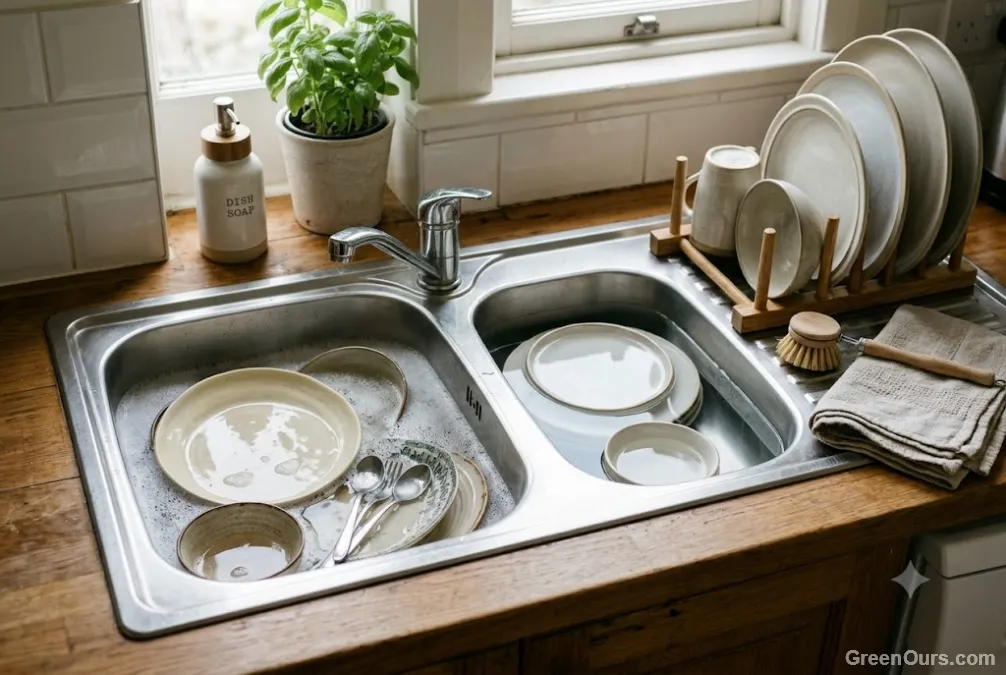
Using one basin for soapy water and another for rinsing can reduce water use because the tap stays off while you scrub. For this illustrative two-basin scenario, the estimate is about 7 gallons across washing and rinsing.
That is a modeled figure, not a national average. Your sink may hold more or need fewer refills. To estimate your own use, measure how much water your basins hold and how often you refill them.
Which Method Uses Less Energy?
Energy comparisons are more complicated because handwashing uses energy at the water heater, while a dishwasher uses electricity to operate the appliance and heat water. Looking only at the electricity listed for a dishwasher can miss some of the energy involved in either method.
ENERGY STAR's current annual energy criterion for standard-size dishwashers is 240 kWh per year or less. Dividing that annual benchmark by the 215 cycles used in the annual estimate gives approximately 1.12 kWh per cycle. This is a derived benchmark based on the criterion, not a measurement of every certified dishwasher's actual cycle.
For handwashing, consider an illustrative electric resistance water-heater calculation. Assume the water is heated by about 65°F, from 55°F to 120°F. Heating one gallon through that temperature rise takes approximately 0.16 kWh under this simplified calculation.
If half of a 22-gallon running-tap session is hot water, heating that 11-gallon hot-water portion takes roughly 1.76 kWh. A basin routine using about 5.6 gallons of hot water takes approximately 0.90 kWh. These are modeled estimates, not measured averages.
Important comparison limitation: These figures do not use perfectly matching calculation boundaries. The dishwasher benchmark includes appliance operation and associated water heating, while the handwashing estimates calculate only the energy needed to heat the assumed hot-water volume. They should therefore be treated as illustrative scenarios rather than a definitive energy-efficiency ranking. Your actual result will depend on your water heater, dishwasher cycle, water temperature and washing routine. Gas and heat-pump water heaters will also change the calculation.
Worth knowing Leaving hot water running while scrubbing can use substantial energy. Reducing hot-water volume is one of the simplest ways to make handwashing more efficient.
Which Costs Less in a US Household?
Here is an illustrative US household cost comparison. The calculation uses placeholder rates of $0.17 per kWh for electricity and $15 per 1,000 gallons for combined water and sewer service. Replace these assumptions with the rates on your own utility bills.
- Dishwasher: 3.2 gallons plus approximately 1.12 kWh comes to roughly $0.24 per load.
- Basin handwashing: About 7 gallons plus 0.90 kWh comes to roughly $0.26 per load.
- Running-tap handwashing: 22 gallons plus 1.76 kWh comes to roughly $0.63 per load.
At 215 loads a year, the running-tap example costs roughly $84 more than the dishwasher under this simplified calculation. The basin example costs about $4 more.
These are illustrative comparisons, not measured household savings or guaranteed results. The energy estimates use different calculation boundaries, and actual costs depend on your water heater, dishwasher and local utility rates. Detergent, appliance purchase price and repairs are not included. ENERGY STAR's published savings estimates use their own assumptions, so the figures here will not necessarily match them.
How Your Dishwashing Habits Change the Results
The same dishwasher can use resources efficiently or waste them, depending on how you use it. A few simple habits can make either washing method more efficient.
- Scrape, don't rinse. ENERGY STAR guidance recommends scraping food scraps instead of pre-rinsing dishes. Pre-rinsing adds water use and can add energy use when hot water is involved.
- Run reasonably full loads. A dishwasher generally uses nearly the same resources per cycle whether the racks are partly or fully loaded. Waiting for a reasonably full load is usually more efficient than running several small loads.
- Skip heated drying. ENERGY STAR guidance notes that using a no-heat drying option can reduce energy use. Check your appliance manual for the available settings.
- Check your eco cycle. Many eco programs trade a longer run time for lower temperatures and reduced resource use. Check your dishwasher manual to understand the options on your model.
Waiting until the dishwasher has a reasonably full load can reduce the number of cycles needed. If you prefer handwashing, using basins and turning off the tap while scrubbing can help limit water and hot-water use.
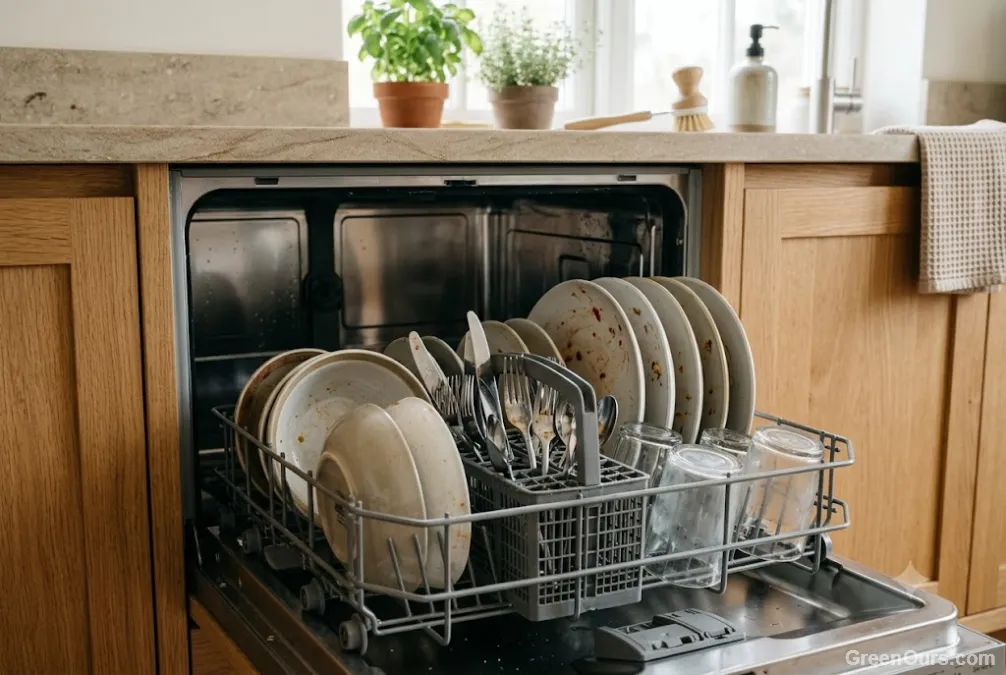
Pro tip At the federal faucet maximum of 2.2 gallons per minute, two minutes of pre-rinsing would use 4.4 gallons. That is more than the 3.2-gallon-per-cycle limit for an ENERGY STAR certified standard-size dishwasher.
Is One Method Better for the Environment?
In the operating-water examples above, an efficient dishwasher and a careful basin wash both use less water than the running-tap scenario. The energy examples also show why limiting hot-water use matters. However, these comparisons do not establish which method has the lowest total environmental impact.
Detergent, appliance manufacturing, product lifespan and disposal also matter. Without comparable lifecycle data for the specific products and routines being compared, it would be misleading to declare one method universally better for the environment.
A practical approach is to use an efficient dishwasher well if you already own one, or to use a careful basin routine if you wash by hand. Avoiding unnecessary rinsing and keeping the tap off while scrubbing are useful habits either way.
When Does Handwashing Make More Sense?
A dishwasher is not always the practical choice. For small amounts of washing, the sink can make more sense.
- A few lightly soiled dishes. A mostly empty dishwasher still uses resources to run a cycle. Washing a few items in a basin may use less.
- Delicate or special items. Wooden spoons, cast iron and sharp knives may require handwashing. Check the care instructions for each item.
- One greasy pan. A quick basin wash may be more practical than waiting to run a nearly empty dishwasher.
How to Make Either Method More Efficient
If you use a dishwasher, scrape plates, wait for a reasonably full load and choose no-heat drying when practical. If you wash by hand, use one basin for soapy water and another for rinsing, and turn the tap off while you scrub.
For the faucet itself, US Department of Energy guidance discusses kitchen faucet flow rates and water-saving options. A compatible lower-flow aerator may reduce water use, provided it still works well for your cleaning needs. Sponges and brushes are a separate decision from water and energy use, but they are part of the same kitchen routine.
FAQs
Is it cheaper to use a dishwasher or wash dishes by hand?
It depends on your appliance, water-heating system, washing routine and utility rates. In the illustrative calculation above, the dishwasher costs less than running-tap handwashing, while careful basin washing comes out close. Use your own utility rates for a more relevant estimate.
Does a dishwasher use less water than handwashing?
Often, yes, when you use a reasonably full, efficient dishwasher load. The examples in this article use 3.2 gallons for an ENERGY STAR certified standard-size dishwasher, compared with about 7 gallons for the modeled basin wash and 22 gallons for the modeled running-tap session. These handwashing figures are examples, not national averages.
How much water does an ENERGY STAR dishwasher use per cycle?
Under the cited criteria, certified standard-size dishwashers are limited to 3.2 gallons per cycle, while certified compact models are limited to 2.0 gallons. Actual use depends on the model and cycle.
Is it more energy-efficient to wash dishes by hand?
It can be, particularly when you use a modest amount of hot water in a basin. Handwashing under a continuously running hot tap can use considerably more energy. The result depends on your water heater, dishwasher and washing routine.
Should you rinse dishes before putting them in the dishwasher?
Usually, no. Scrape food scraps into the trash or compost instead of pre-rinsing. Check your dishwasher manual for any specific loading or cleaning instructions.
Is it wasteful to run a dishwasher half full?
It is generally more efficient to wait for a reasonably full load. A dishwasher uses resources for each cycle, even when the racks are only partly filled. If your model has a suitable half-load setting, check its manual to see how that option changes resource use.
Is handwashing better if you only have a few dishes?
Often, yes. Washing a few items in a basin can use fewer resources than running a nearly empty dishwasher cycle.
What to Try First
Try one simple experiment this week: wash a dishwasher-sized batch of dishes in two basins and measure how much water you use. Compare that with your dishwasher's published water-use figure, if available. The result will give you a better idea of how your own routine compares.
Whichever method you choose, avoid leaving hot water running while you scrub.
Curious what else in your kitchen quietly adds up? There's plenty more to explore on GreenOurs.
More ways to waste less in your kitchen