
Why Speed Matters More Than You Think
There's a real psychological difference between waiting three months for a harvest and waiting three weeks. When you see results quickly, you start paying closer attention. You notice how the soil dries out, how seedlings lean toward light, how quickly a plant can go from tiny to thriving. That attention is what turns a beginner into someone who actually understands their garden, not just someone following instructions.
Quick crops also forgive mistakes. If you mistime a planting or the weather turns, you've lost a few weeks, not a whole season. That lower-stakes environment is exactly where you want to be while you're still learning what your specific patch of soil, light, and weather can support.
They also make small spaces more rewarding. You don't need a large vegetable bed to grow something useful. A container, balcony planter, raised bed, or even a shallow tray can produce a harvest surprisingly quickly when you choose crops that are naturally suited to short growing cycles.
What “Under 30 Days” Really Means
Harvest times on seed packets are useful targets, but they aren't guarantees. The number of days depends on the variety, temperature, sunlight, moisture, soil conditions, and the stage at which you harvest the crop.
Some vegetables on this list can produce a harvest of baby leaves in under 30 days even though the same plants would need considerably longer to reach full maturity. Microgreens are different again because they are deliberately harvested while they are still very young. Radishes can sometimes reach usable size in three to four weeks, but slower conditions can push that date back.
Think of “under 30 days” as a realistic opportunity to start harvesting rather than a countdown that every plant must meet. Good growing conditions make a much bigger difference than shaving a few days off the seed packet estimate.
Fast-Growing Vegetables at a Glance
| Crop | First harvest | Best harvest stage | Container friendly |
|---|---|---|---|
| Radishes | 21–28 days | Young roots | Yes |
| Loose-leaf lettuce | About 21 days | Baby leaves | Yes |
| Baby spinach | About 21–30 days | Baby leaves | Yes |
| Arugula | About 20–30 days | Young leaves | Yes |
| Mizuna | About 20–30 days | Young leaves | Yes |
| Tatsoi | About 20–30 days | Young leaves | Yes |
| Baby bok choy | About 25–30 days | Baby leaves or small heads | Yes |
| Turnips | About 25–30 days | Baby roots | Yes |
| Pea shoots | About 10–21 days | Young shoots | Yes |
| Microgreens | About 7–14 days | Young shoots | Excellent |
Fast Root Vegetables: Radishes and Turnips
Radishes: One of the Fastest Root Vegetables You Can Grow
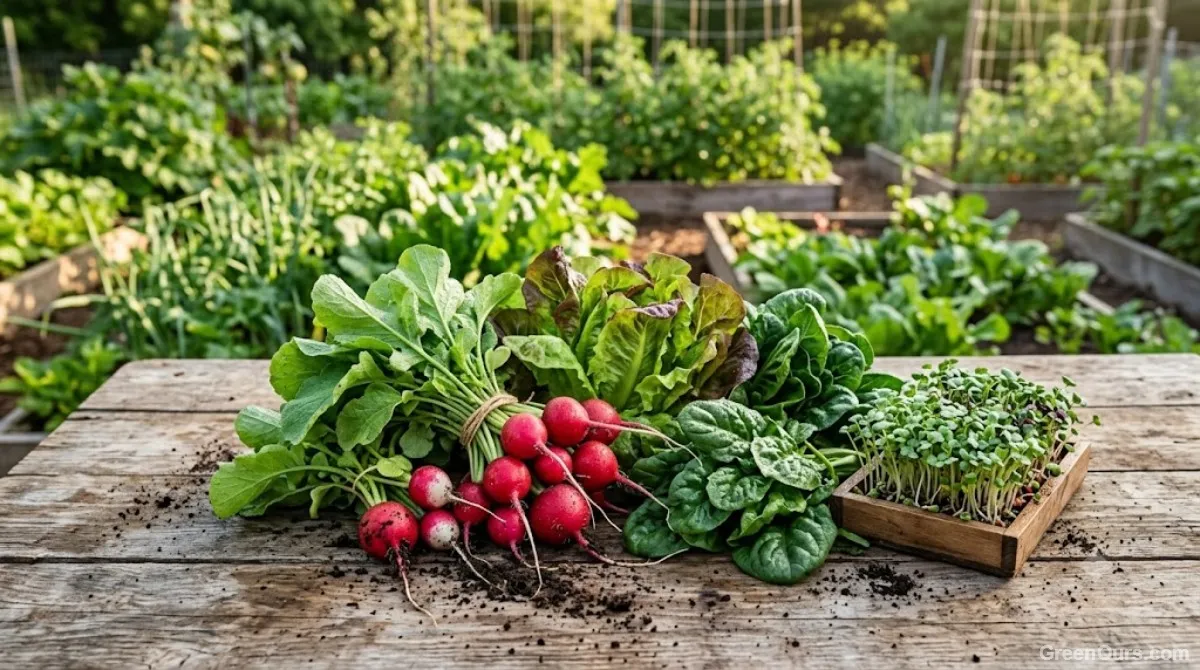
Radishes are among the quickest root vegetables for home gardeners. Many early varieties are ready to harvest in roughly 21 to 28 days from sowing under favorable conditions, and they don't ask for much in return.
Sow radish seeds directly into loose, well-draining soil about half an inch deep, spaced roughly an inch apart. Thin the seedlings once they emerge so each root has room to swell. Crowded radishes stay skinny and can become tough before they're worth eating.
Keep the soil consistently moist while the roots are developing. Radishes that repeatedly dry out and then receive a large amount of water can split, while uneven growing conditions can also produce misshapen roots.
For the quickest results, choose an early-maturing variety and harvest when the roots have reached a useful size rather than waiting for maximum size. Young radishes are often crisp and mild, while leaving them in the ground too long can make some varieties woody or overly pungent.
Turnips: Fast Roots When You Harvest Them Young
Turnips are often associated with larger mature roots, but you don't have to wait that long. Some quick varieties can produce small, tender roots in roughly four weeks when grown under good conditions.
Sow directly into loose soil and thin the seedlings early. Like radishes, turnips need enough space for their roots to develop. Young turnip greens can also be harvested lightly while the root continues to grow.
If your goal is speed, harvest smaller roots rather than waiting for them to reach their maximum advertised size. The result is a shorter growing cycle and often a more tender texture.
If your radishes are producing lush green tops but small, disappointing roots, the plants may be overcrowded or receiving too much nitrogen. Thin them properly and avoid heavy feeding on your next planting.
Leafy Greens That Reward You in Stages
Leafy greens work differently from radishes, and that's part of what makes them worth growing alongside them. Instead of waiting for one large harvest at the end, you can often take smaller harvests as the plants develop.
Loose-Leaf Lettuce and Baby Spinach
Loose-leaf lettuce and baby spinach can provide a first light harvest in roughly three weeks when growing conditions are favorable and the leaves are picked young. Use the cut-and-come-again approach: remove the larger outer leaves while leaving the growing center intact.
Don't strip the plant completely. Leaving the central growing point gives it a chance to continue producing new leaves. Harvesting lightly also makes it easier to extend the useful life of a small planting.
Arugula
Arugula is another excellent choice when speed matters. Its young leaves can be harvested while they are still small and tender, often within a few weeks of sowing. The peppery flavor becomes stronger as the leaves mature, so harvesting young is useful if you prefer a milder taste.
Sow small amounts every week or two instead of planting an entire packet at once. That gives you a more reliable supply of young leaves rather than a large crop that all reaches harvest at the same time.
Asian Greens Worth a Try
Tatsoi, mizuna, and baby bok choy are underused by beginners but can grow quickly enough to fit a short-season garden. Their flavors and textures are different from ordinary lettuce, which makes them useful when you want more variety without committing to a long growing cycle.
Many Asian greens also perform well in cooler conditions. That can make them useful choices for early or late-season planting, although the ideal timing still depends on the specific variety and your local weather.
Pea Shoots and Microgreens: Harvest Before the Plant Looks Like a Vegetable
Pea Shoots: A Fast Harvest From Seeds
Pea shoots are another useful option when you're interested in harvesting the plant rather than waiting for pods. Soak suitable pea seeds if recommended for your variety, sow them densely in a shallow container, and harvest the tender shoots once they have developed several inches of growth.
Use clean scissors to cut the upper shoots while leaving enough growth for the plant to continue producing. Pea shoots are especially useful for containers and small-space gardens because you can grow a meaningful harvest without needing a deep vegetable bed.
Microgreens: Ready in One to Two Weeks
If radishes feel fast, microgreens will feel like cheating. Many common varieties, including radish, pea, broccoli, and sunflower microgreens, can be ready to cut in roughly 7 to 14 days, depending on the crop and growing conditions.
You don't need a garden bed. Fill a shallow tray with about an inch of seed-starting mix or another suitable growing medium, scatter the seeds across the surface, and press them in gently. Follow the seed supplier's instructions for whether the seeds should be lightly covered.
Keep the growing medium evenly moist without leaving it waterlogged. Bright light after germination helps produce compact, healthy growth. Once the young plants reach the preferred harvest stage, snip them close to the growing medium with clean scissors.
Microgreens are harvested very young, so their short growing time should not be compared directly with the time required to grow a mature vegetable. Their advantage is that you can produce a fresh harvest from a small tray in a very short space of time.
Simple Planting Tips That Make a Real Difference
Fast crops still need the basics to be right. Keep the soil surface consistently moist during germination because a dry crust can prevent small seedlings from emerging evenly. Once plants are established, water deeply enough to keep their root zone from repeatedly drying out, while avoiding constantly saturated soil.
Light matters too. A sunny outdoor position is usually ideal for many quick vegetable crops, while indoor trays may need a bright window or suitable grow light. If seedlings become tall, pale, or weak, insufficient light may be slowing them down even if everything else looks correct.
Spacing is another easy detail to underestimate. It can be tempting to leave seedlings crowded because the plants look tiny at first, but competition becomes a problem surprisingly quickly. Follow the spacing recommendations for your variety, especially for crops grown for roots.
Growing Fast Vegetables in Containers
You don't need a traditional vegetable garden to grow quick crops. Containers work particularly well for leafy greens, radishes, arugula, turnips, Asian greens, and microgreens.
Choose a container with drainage holes and use a suitable growing medium rather than heavy garden soil that can become compacted. Shallow containers are enough for many leafy greens and microgreens, while root crops need enough depth for the variety you choose.
Container soil can dry out faster than garden soil, especially in warm or windy weather, so check moisture regularly. At the same time, make sure excess water can drain freely. A container that stays saturated can create just as many problems as one that dries out.
Why Your 21-Day Crop Took 35 Days
A harvest date printed on a seed packet assumes reasonably favorable growing conditions. If your crop is taking longer, that doesn't necessarily mean you've done something wrong.
Temperature
Cool-season vegetables generally prefer moderate temperatures. Cold soil can slow germination and early growth, while excessive heat can cause some leafy crops to bolt or become bitter. Planting within the recommended seasonal window is often more effective than trying to compensate with extra fertilizer.
Light
Plants need enough light to produce the energy required for steady growth. A crop growing in deep shade may survive but won't necessarily develop at the speed shown on the packet.
Water
Repeated cycles of severe drying followed by heavy watering can interrupt growth. Aim for consistent moisture rather than keeping the soil permanently wet.
Spacing
Overcrowded seedlings compete for light, water, nutrients, and root space. Thinning may feel wasteful when the plants are young, but it often results in healthier and faster-growing plants.
Variety
Not every radish, lettuce, or turnip variety has the same maturity time. If speed is your main goal, look specifically for early-maturing varieties rather than assuming every variety of the crop will perform identically.
Succession Planting and Choosing Crops for Your Season
Succession Planting: The Secret to Continuous Harvests
The fastest crop in the garden isn't very useful if everything becomes ready on the same weekend. Succession planting solves that problem by spreading your sowing dates across several weeks.
Instead of planting all your radishes at once, sow a small row this week, another next week, and another the week after. Do the same with lettuce, arugula, spinach, and other quick greens. As one planting approaches its harvest window, another is still developing.
This simple habit turns a short harvest period into a much longer supply. It also reduces the risk of losing your entire crop to one spell of poor weather or a single growing mistake.
Choosing Fast Crops for Your Season
Speed is not the only factor when deciding what to plant. The fastest crop on paper may struggle if the weather is wrong for it.
In cooler parts of the growing season, radishes, spinach, lettuce, arugula, mizuna, tatsoi, and other cool-season greens can be excellent choices. When temperatures rise, look for varieties known to tolerate warmer conditions and pay closer attention to watering and afternoon heat.
If outdoor conditions are difficult, microgreens and other tray-grown crops give you more control. Their short growing cycle also makes them useful for experimenting with indoor growing before committing to a larger vegetable garden.
Start with smaller plantings than you think you need. It's much easier to sow another row when the first one is nearly finished than to find yourself with more mature lettuce or radishes than you can eat.
Common Mistakes That Slow Fast Crops Down
- Planting too deeply: Small seeds often struggle when buried much deeper than recommended.
- Skipping thinning: Crowded root crops rarely develop as well as properly spaced plants.
- Letting seedlings dry out: Young roots are especially vulnerable to inconsistent moisture.
- Overfertilizing: More fertilizer does not automatically mean faster growth.
- Ignoring sunlight: Insufficient light can make even a naturally fast crop grow slowly.
- Planting everything at once: Succession planting usually produces a more useful harvest pattern.
- Waiting too long: Some baby-leaf crops are at their best before they reach full maturity.
Building Momentum From Here
Once you've pulled your first radish, cut a handful of arugula, or snipped your first tray of microgreens, something shifts. You've seen the whole cycle, start to finish, and you know you can do it again.
That's worth more than any single harvest. It's the confidence that makes slower, more demanding crops feel approachable instead of intimidating. And because quick crops can be replanted repeatedly, every short growing cycle gives you another chance to improve.
Start with one or two crops, pay attention to what happens, and make small adjustments with each planting. Your first harvest doesn't have to be perfect. It just needs to teach you something useful for the next one.
Start small, start fast, and let the first harvest do the convincing. The rest of the garden can wait for you to catch up.
Explore more beginner vegetable guides